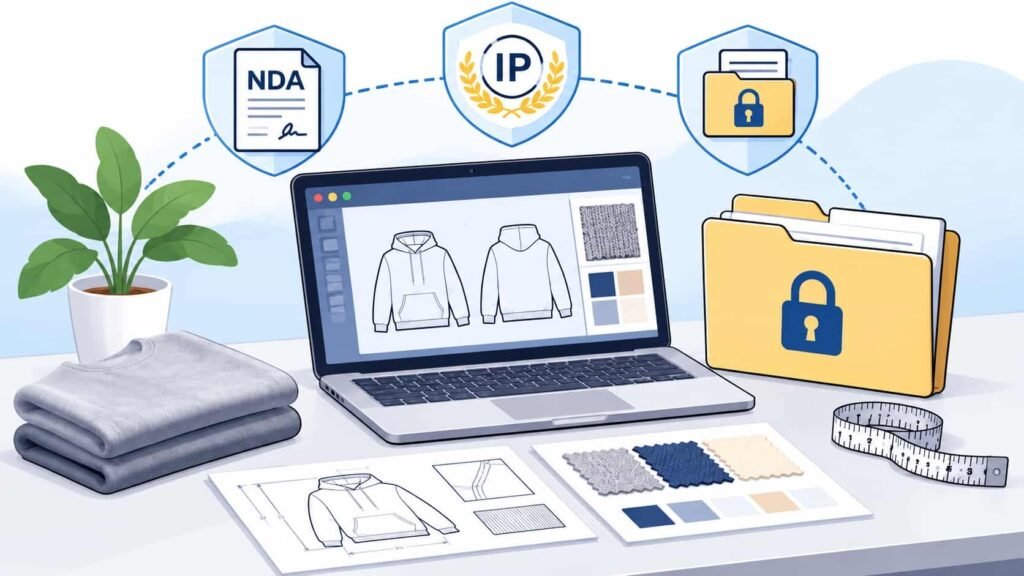
A new apparel project often becomes commercially sensitive long before the first garment reaches a sewing line. During the first few conversations, a brand may send an unreleased design, a detailed Tech Pack, custom artwork, target pricing, forecast quantities, launch timing, packaging concepts and reference samples. Each item may look routine in isolation, yet together they can expose enough information to reconstruct not only the product but also the brand’s sourcing strategy, development priorities and commercial schedule.
Confidentiality in OEM and ODM apparel projects should be managed through written agreements, clearly defined confidential information, need-to-know access, controlled supplier disclosure, sample and file management, agreed ownership terms, publication restrictions and post-project retention rules. An NDA is useful, but effective protection depends on how information is handled throughout development, sampling, production and project closure.
The practical test is simple. Imagine that an unreleased sports bra sample is photographed during a factory visit, its Tech Pack is later forwarded to a trim supplier, and months later the same sample appears in a sales presentation. None of those events is solved merely by saying, “We signed an NDA.” The stronger question is whether the project created clear rules before those moments occurred, whether people understood those rules, and whether the manufacturer can explain how files, samples, third parties and old project materials are actually controlled.
What Information Should Be Kept Confidential?
Confidential information in an OEM or ODM apparel project includes any non-public design, technical, commercial, branding or operational data that could expose a product, business relationship or sourcing strategy if reused or disclosed without authorization. Protection should cover digital files and physical materials, including Tech Packs, patterns, samples, artwork, BOMs, quotations, order quantities, custom materials, packaging and launch information.
Which Design Files Are Sensitive?
A garment becomes easier to reproduce as technical information accumulates. A public product photograph may reveal the silhouette, but a Tech Pack can expose measurements, seam placement, stitch requirements, panel geometry, artwork size, fabric construction, trim references and revision history. Patterns and graded nests go further because they translate design intent into production geometry. For that reason, confidentiality should not stop at files labeled “design.” CAD files, measurement charts, fit comments, construction drawings, color standards and editable artwork may all require controlled access. Source files deserve particular attention because they can be altered or reused more easily than flattened PDFs. Brands should also distinguish their original files from new working assets created during development, such as production patterns or marker files, because delivery, ownership and retention of those outputs should be agreed rather than assumed.
What Commercial Information Needs Protection?
Commercial information is frequently underestimated because it does not look like intellectual property. Yet quotations, target costs, forecast quantities, planned launch dates, expected order volumes, supplier nominations and packaging instructions can reveal how a brand intends to compete. A sourcing partner that sees the entire program may understand which styles are intended as volume drivers, how many colorways are planned and when inventory must reach the destination market. That information can have commercial value even if the design is already visible publicly. A practical confidentiality model therefore separates manufacturing information from business information and shares only what each function needs. The pattern team does not need payment data, the packaging supplier does not need a complete costing sheet, and the freight forwarder does not need a graded pattern.
Are Samples and Materials Confidential?
Physical samples can disclose almost as much as digital files. A development sample may reveal fit, panel placement, stitching, bonding, trims, logo position and material combinations before a collection launches. Custom fabrics, special elastics, branded labels and distinctive packaging can also reveal an unreleased product direction. Sample control should therefore address storage, internal viewing, photography, factory tours, trade fairs, sales meetings, disposal and return. Branded excess materials deserve similar treatment because authentic labels, hangtags and packaging can make an unauthorized garment appear legitimate. For manufacturers working across multiple brands, the practical rule is that customer-specific samples and materials should remain within the authorized project purpose unless the customer has approved another use.
What Should Brands Classify First?
A project does not need an elaborate corporate classification program before sampling can begin, but it does need a consistent distinction between information that is public, internal, confidential and highly restricted. Public information may circulate normally; internal information remains within the business relationship; confidential information is limited to people working on the project; and highly restricted items such as unreleased patterns, source artwork or sensitive commercial plans may require named access. The value of classification is consistency rather than bureaucracy. A file should not be treated as highly confidential by the brand while being casually forwarded through several supplier channels later. The classification should shape practical behavior: who receives the file, how it is stored, whether it can be photographed, and what happens when its production purpose ends.
| Information Category | Typical Examples | Sensitivity | Practical Control |
| Design concept | Sketches, CADs, reference images | High | Limit to development and costing roles |
| Technical specification | Tech Pack, measurement chart, BOM | High | Use project folders and version control |
| Production geometry | Patterns, grading, marker files | High | Restrict editing and redistribution |
| Branding | Logos, prints, label artwork | High | Release approved production files only |
| Commercial data | Prices, quantities, forecasts, launch timing | High | Share by business need |
| Released product data | Public catalog information | Lower | Confirm that the information is genuinely public |

When Should an NDA Be Used?
An NDA should be considered before a brand releases information that would allow a supplier to understand, reproduce or commercially exploit a confidential product or business plan. Initial capability screening can often use limited information, while detailed Tech Packs, patterns, artwork, unreleased samples and sensitive commercial data should normally follow an agreed confidentiality framework.
Should an NDA Be Signed Before File Sharing?
The safest approach is staged disclosure. A brand rarely needs to send its complete technical package just to determine whether a manufacturer can produce sports bras, leggings, swimwear or hoodies. Product category, approximate quantity, general construction and material direction are often enough for a first capability review. Once the supplier appears suitable, confidentiality terms can be reviewed before releasing the information required for accurate costing or development. This creates a natural boundary between supplier qualification and confidential project execution. The sensitivity of the project still matters: an already released reorder may need less restrictive handling than a pre-launch collection containing proprietary pattern work, custom fabric development or an unannounced retail program. The control should fit the risk rather than forcing every inquiry through the same process.
What Should an Apparel NDA Cover?
A useful apparel NDA should make the operational boundaries understandable. It normally identifies the parties, defines confidential information, explains the permitted project purpose and establishes restrictions on disclosure or unauthorized reuse. For apparel development, the scope may include Tech Packs, patterns, samples, artwork, BOMs, prices, quantities, launch plans, packaging and supplier information. It may also need to clarify whether selected material, trim, testing or packaging suppliers can receive limited information to complete their work. The agreement can address required legal disclosure, confidentiality duration, incident reporting and post-project return or destruction. If ownership, editable source-file delivery or exclusivity is commercially important, those subjects should be written separately rather than assumed to be solved by a confidentiality clause alone.
Is an NDA Enough by Itself?
No contract can prevent every operational mistake. An employee may attach the wrong file, a supplier may receive more information than needed, or a visitor may photograph an unreleased sample. That is why daily handling determines whether the written promise is meaningful. Stronger projects connect confidentiality to file naming, permission control, supplier communication, sample storage, version approval and publication rules. A useful supplier-evaluation conversation therefore goes beyond asking whether an NDA can be signed. Ask who receives the files, how artwork is sent to outside suppliers, what happens to obsolete versions, whether samples can be photographed, who approves case-study publication and how a mistaken disclosure would be handled. Those questions reveal whether confidentiality exists in routine manufacturing behavior rather than only in legal paperwork.
How Long Should Confidentiality Last?
The appropriate duration depends on the information and the agreement. A confidential launch date may lose most of its commercial sensitivity once the collection is public, while a proprietary pattern, sourcing combination or manufacturing method may remain valuable for much longer. For that reason, fixed periods should not be copied mechanically from unrelated contracts. The parties should consider whether information remains confidential after launch, after the last order or after the commercial relationship ends, and whether some information qualifies as a longer-lived trade secret. Shenzhen Leadshow’s current company framework does not present one permanent confidentiality period or one universal NDA as applying to every customer; confidentiality timing and scope are reviewed according to the project and written agreement.
| Project Stage | Typical Information Shared | Priority | Practical Release Gate |
| Supplier screening | Category, broad quantity, basic references | Low-Medium | Basic capability fit confirmed |
| Feasibility review | Construction and material direction | Medium | Relevant technical contacts identified |
| Detailed quotation | Tech Pack, BOM, artwork | High | Confidentiality terms reviewed |
| Sampling | Patterns, fit notes, branded assets | High | Controlled project access established |
| Pre-production | Approved files, labels, packaging | High | Production version formally released |
| Project closure | Archives, samples, retained records | Controlled | Retention and disposal terms applied |

How Should Project Access Be Controlled?
Project access should follow a need-to-know and minimum-necessary principle. Each employee, factory function or external supplier should receive only the information required to perform its task. This reduces unnecessary exposure while allowing merchandising, engineering, sampling, production, quality, packaging and logistics teams to work efficiently from the correct approved information.
Who Needs Access to Project Files?
Different apparel functions need different slices of the same project. The development team may need the complete Tech Pack, while the warehouse may only need SKU, quantity, labeling and packing instructions. A fabric supplier needs fabric specifications but rarely needs the customer’s full pattern package, and a freight forwarder needs shipment information rather than design source files. This separation becomes more valuable as projects grow because multi-SKU programs can involve several fabrics, colorways, label sets and packaging configurations. Giving everyone full access may appear convenient, but it increases the number of places where confidential material can be copied, misdirected or retained. A stronger approach maps information to responsibility so access can be explained in operational terms rather than as a vague promise that a project is ‘secure.’
How Should Files Be Shared and Versioned?
Version control protects both confidentiality and manufacturing accuracy. A private file can still cause expensive problems if it is obsolete. Important documents should therefore carry a clear version, date or approval status, including Tech Packs, measurement charts, BOMs, patterns, artwork, color references, labels, packaging instructions and quality requirements. When a revision is approved, teams should understand what changed and which earlier file is no longer valid. Quotation versions, development versions and production-approved versions should not be mixed. For manufacturing, a practical rule is to maintain one active approved reference for each controlled production document. Older versions can remain archived when traceability is necessary, but they should not compete with the current version on the production floor or in supplier communication.
How Should Suppliers Receive Confidential Data?
Apparel manufacturing often depends on specialist suppliers for fabrics, zippers, elastics, labels, packaging, testing and selected decorative processes. The objective is not to prevent all external sharing; the objective is to make each disclosure purposeful and limited. A heat-transfer label supplier may need approved artwork, dimensions, material, color and quantity, but not the brand’s launch plan, retail pricing or garment pattern. A testing organization may need product and material identification but not the full commercial file. When disclosure is task-specific, it becomes easier to control and easier to audit. The manufacturer can explain what information left the project team, why it was required and whether the outside party was authorized to receive it.
Do AI Tools Need Confidentiality Review?
Yes. Generative AI, online translation systems, file-conversion services and external collaboration tools are additional information-processing channels, so they should be considered in the same confidentiality review as any other outside service. Before uploading an unreleased Tech Pack, sample image, quotation or customer artwork, the team should ask whether the full file is necessary, whether sensitive details can be removed, what account or contractual terms apply, and whether the customer has restricted external processing. A translation task may not need the customer’s name, price or complete design, and a general technical question may be answerable without uploading a project file at all. Leadshow’s current confidentiality framework explicitly treats AI use as subject to project confidentiality review rather than presenting external AI processing as automatically safe.
| Role or Partner | Usually Needs | Usually Does Not Need | Control Value |
| Merchandising | Project scope, quantity, current specifications | Unrelated customer files | Coordinates the correct project |
| Pattern team | Measurements, construction, fit comments | Payment and shipping records | Limits technical IP exposure |
| Sample team | Pattern, materials, workmanship notes | Full sales forecast | Keeps development focused |
| Label supplier | Artwork, size, color, quantity | Pattern and costing | Minimizes downstream disclosure |
| Quality team | Approved specs, tolerances, sample | Negotiation history | Supports objective inspection |
| Forwarder | Shipment and consignee information | Tech Pack and patterns | Separates logistics from product IP |

How Do OEM and ODM Rights Differ?
OEM and ODM describe how a product is developed and manufactured, but they do not automatically determine ownership, confidentiality or exclusivity. OEM projects often begin with customer-controlled specifications, while ODM development may combine customer direction with manufacturer-created or pre-existing assets. Patterns, source files, manufacturing know-how and exclusive rights should therefore be identified and agreed separately.
Who Owns Customer-Provided OEM Files?
In an OEM project, the brand may provide a complete Tech Pack, artwork, measurements, approved sample or other production specifications. Those customer-owned materials should remain within the authorized project purpose unless the agreement says otherwise. The more complicated question begins when manufacturing creates new working assets. A factory may prepare a production pattern, cutting marker, construction worksheet or process instruction from the customer’s Tech Pack. The original specification and the newly generated manufacturing file are related, but they are not necessarily the same legal asset. Brands should therefore clarify who owns the original input, who owns newly created development output, which editable files must be delivered and what may be retained for repeat production. Paying a sample fee should not be treated as automatic transfer of every file generated during the project.
Who Owns an ODM Development?
ODM development is more likely to have a mixed origin. A project may begin with a customer concept, sketch or reference image and then move through material selection, construction review, pattern development and sample revisions. It may also start from a manufacturer’s existing product direction or pattern block. That creates several possible ownership layers: the brand may own its logo and original concept, the manufacturer may retain pre-existing development assets or general manufacturing know-how, and newly created patterns or source files may be transferred, licensed or retained according to the agreement. The practical question is therefore not simply ‘Who owns the ODM design?’ but ‘Which specific project asset are we discussing, where did it originate, and what rights were agreed for that asset?’
Is Confidentiality the Same as Ownership?
No. These concepts answer different commercial questions, and treating them as interchangeable is a common source of disagreement. Confidentiality controls who may see, disclose or use information. Ownership determines who controls the underlying asset or right. Exclusivity determines whether a design, pattern or product may be used or supplied to other parties. A manufacturer could own an existing pattern block while agreeing to keep a customer’s unreleased adaptation confidential. A brand could own its artwork while having no ownership of the manufacturer’s general sewing knowledge. A customer-specific pattern could be confidential without being globally exclusive, and an exclusive arrangement could apply only to a defined territory or period. Separating these concepts in the project documents makes the commercial expectation much clearer.
How Should Exclusivity Be Defined?
The word ‘exclusive’ needs boundaries to be useful. A commercially workable arrangement should identify whether exclusivity applies to the finished style, a pattern, a specific construction detail, a fabric, a color combination, a market or a sales channel. It should also define geography, duration, purchasing commitments, fees, exceptions and termination conditions. Otherwise, the customer may believe it has secured an exclusive garment while the manufacturer believes only one modification or market is restricted. Leadshow’s current company framework does not present ODM as automatically exclusive. Product, pattern, territory, timing, purchasing conditions and source-file rights are treated as matters for the individual development agreement, which is a more precise approach for projects where both customer and manufacturer inputs may exist.
| Asset or Right | Common Origin | Main Question | What to Confirm |
| Brand logo | Customer | Who may use it? | Permitted manufacturing scope |
| Original Tech Pack | Customer | Can it be reused? | Project-only use and disclosure |
| New production pattern | Development process | Who owns/delivers it? | Ownership, source-file delivery, retention |
| Existing pattern block | Manufacturer | Did it pre-date the project? | Permitted modification and reuse |
| Manufacturing know-how | Manufacturer | Is it project-specific? | Confidentiality boundary, not automatic transfer |
| Exclusivity | Negotiated right | What exactly is restricted? | Asset, territory, duration, volume, termination |

How Should Confidentiality Continue After Development?
Confidentiality should continue through production, shipment, repeat-order support and project closure according to the agreement and the sensitivity of the information. Approved samples, branded overruns, patterns, packaging, production photographs, quality records and archived files can remain sensitive after development ends, so retention, publication, return and destruction rules should be defined rather than left to assumption.
How Should Samples and Overruns Be Controlled?
Sampling creates several physical versions of the same product, including prototypes, fit samples, revised fit samples, size sets, pre-production samples and production references. Some remain necessary for manufacturing or quality comparison, while others become obsolete. A practical control system identifies each sample by status and purpose so an approved production reference is not confused with a rejected development sample. Branded overruns require similar attention because finished garments, labels, hangtags and packaging may have commercial value even when they fall outside the saleable order quantity. The project should therefore define whether excess branded materials can be retained for reorders, returned, destroyed or handled another agreed way. Physical control matters because an authentic label and package can make an unauthorized garment appear legitimate.
Can a Factory Show Customer Products?
Manufacturing a product does not automatically create a right to use it in marketing. Website case studies, social posts, exhibition displays, showroom samples, customer presentations and factory-tour photography can all expose confidential information. Even when the garment is already public, the business relationship, order volume or development history may remain private. Publication approval should therefore be specific enough to avoid assumptions. A customer may allow an anonymous close-up of a seam but prohibit its logo, may approve imagery only after launch, or may allow the product to be shown while keeping its name confidential. For a manufacturer, the safer operating rule is that customer names, logos, unreleased products and sensitive project images are not used publicly until the applicable authorization is clear.
What Happens to Files After the Project Ends?
Project closure does not automatically mean every file should be deleted. Repeat-order manufacturing may require approved patterns, BOMs, color references and packaging files, while quality, financial or contractual records may need to remain available for legitimate business or legal reasons. At the same time, unlimited retention creates unnecessary exposure, especially when old working files no longer serve an authorized purpose. A closure review should distinguish active repeat-order references, mandatory records, editable source files, obsolete development material and items scheduled for return or destruction. Ownership and retention should also remain separate concepts: a manufacturer may retain an agreed production reference without acquiring ownership of the customer’s underlying intellectual property.
How Should a Confidentiality Incident Be Handled?
A confidentiality incident should be contained before it is debated. If a file, image, sample or account may have been exposed, further sharing should be stopped as quickly as practical, links or permissions should be revoked where possible, and the team should identify what was disclosed, who received it and when. Relevant evidence should be preserved rather than erased in panic because emails, screenshots, account records and communication history may be needed to determine the scope and root cause. The next steps depend on the agreement and seriousness of the event, but may include contacting an unintended recipient, requesting deletion or return, recovering samples, resetting credentials, reviewing supplier access, escalating internally and implementing corrective action. A credible manufacturer does not promise that incidents can never happen; it should be able to explain how they are contained, investigated and prevented from recurring.
| Post-Development Asset | Possible Status | Main Risk | Control Question |
| Proto or rejected sample | Obsolete | Unauthorized display or reuse | Retain, return or dispose? |
| PP / production reference | Active benchmark | Loss of approved reference | Where is it stored and who may use it? |
| Branded overrun | Excess production | Unauthorized sale | What disposition is approved? |
| Labels and hangtags | Excess brand material | Counterfeit appearance | Retain, return or destroy? |
| Patterns / source files | Archive or repeat-order reference | Uncontrolled reuse | Ownership and retention period? |
| Project photography | Marketing or quality record | Unauthorized publication | Is publication approved? |

Managing Confidentiality as Part of the Manufacturing Process
The strongest confidentiality process is not the one with the most dramatic promise. It is the one that can explain what information is sensitive, when protection begins, who needs access, how outside suppliers receive data, which version is approved for production, how customer products are kept out of unauthorized marketing, how ownership differs from exclusivity, and what happens when a project ends. That approach also supports better manufacturing discipline because the same controls that reduce information exposure often improve specification accuracy, sample traceability and sample-to-bulk alignment. In other words, confidentiality is not separate from product development; it is part of the way a serious OEM or ODM apparel project is organized.
Shenzhen Leadshow Sports Technology Co., Ltd. supports OEM and ODM apparel development and manufacturing for sportswear, swimwear, streetwear and modest sportswear. Depending on the project, the workflow can include technical review, pattern and sample development, material and workmanship evaluation, bulk manufacturing, quality control, custom labels, packaging and export-delivery support. Customer-specific confidentiality requirements and NDA terms are reviewed according to the applicable project and written agreement rather than presented as a blanket guarantee. If you are preparing a custom apparel program, you can begin with the product category, expected quantity, Tech Pack or reference material, branding requirements and any confidentiality conditions that should be reviewed before sensitive development files are released.
For a useful project review, send the latest available technical package rather than several competing versions, identify which files or samples are confidential, state whether special ownership or exclusivity terms need discussion, and explain the intended product, quantity and target market. That gives the development and manufacturing team enough context to evaluate feasibility, sampling requirements, materials, production conditions, labels, packaging and the information-handling boundaries that should be clarified before the project moves deeper into development.