
An apparel RFQ can look complete and still be impossible to quote correctly. The trouble often begins with something that appears small: the RFQ asks for 240 GSM fabric while the Tech Pack says 220 GSM, an artwork file shows an 80 mm logo while a later comment requests 100 mm, or the packaging sheet calls for individual polybags while the commercial request assumes bulk packing. Each detail can change material consumption, labor, supplier minimums, sample scope, packing cost, and timing, so the factory may be looking at several different products even though everyone is using the same style name.
When an apparel RFQ contains conflicting specifications, the manufacturer should identify the contradiction, isolate the affected work, request one controlling instruction, and make any temporary quotation assumptions visible. A final quote, approved sample, or production release should not rely on two incompatible requirements. If the conflict stays unresolved, the result can be incomparable prices, repeated samples, cost revisions, schedule changes, and disputes during bulk production.
Picture three factories quoting the same sports top. One follows the Tech Pack, another follows the latest email, and the third copies the reference sample. The lowest price may look attractive, but the three factories have not actually priced the same garment. That is the moment when a documentation issue becomes a sourcing decision.
What Counts as a Conflicting RFQ Specification?
| A conflicting RFQ specification exists when two or more project instructions cannot be followed at the same time. The mismatch may involve fabric, measurements, construction, artwork, quantity, packaging, testing, or delivery, and it may appear across the RFQ, Tech Pack, BOM, sample comments, artwork files, emails, or purchase order. |

Which Details Usually Conflict?
The easiest conflicts to spot are numerical. One file specifies 220 GSM and another says 250 GSM; the RFQ requests 5,000 pieces but the size-and-color breakdown totals 4,760; or one artwork reference shows an 80 mm logo while another calls for 100 mm. These mismatches are visible because the values do not agree, yet they can still change material planning, price tiers, artwork setup, sample approvals, or the final appearance of the garment if nobody resolves them before work continues.
Technical conflicts are often harder because both instructions may sound reasonable. A flat sketch may suggest one seam construction while the written workmanship notes describe another, or a BOM may list nylon/elastane while a sourcing message refers to polyester/elastane. Packaging can create the same hidden problem when one file assumes individual polybags and another specifies multi-piece pre-packs, barcode labels, retail presentation, or a different carton assortment. In each case, the factory needs one executable requirement rather than two plausible alternatives.
How Do Cross-Document Conflicts Start?
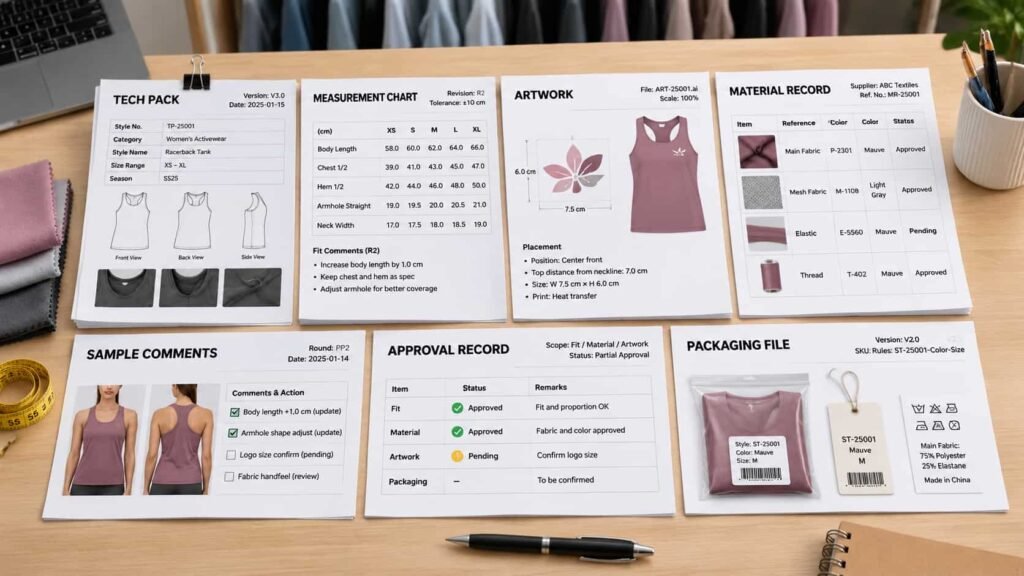
Most apparel projects are controlled by several records rather than one master file. A typical development package may include an RFQ, Tech Pack, BOM, measurement chart, color reference, artwork folder, fit comments, packing specification, quotation, purchase order, and ongoing email or messaging threads. A conflict often starts when one of those records changes and the related files do not. The pattern team may receive the new measurement while the costing team still sees the old Tech Pack, so both groups can be working carefully and still be working from different product definitions.
File age does not solve the problem by itself. A document created yesterday is not automatically more authoritative than a formally approved record created last week, and a file called FINAL or LATEST may still be an unapproved draft. What matters is revision identity, approval status, and the purpose of the record. The same applies to informal comments such as ‘make the logo slightly larger.’ Unless that instruction becomes a controlled dimension in the artwork or placement record, different departments can interpret the change differently and carry that inconsistency into sampling or bulk preparation.
Is Missing Information the Same as a Conflict?
Missing, ambiguous, and conflicting information should be separated because they create different decisions. Missing information means no instruction has been supplied, such as an RFQ that does not state the zipper finish. Ambiguous information means a direction exists but is not precise enough to execute consistently, such as ‘use a premium soft fabric’ without a defined composition, weight, finish, stretch profile, or approved reference. A conflict is more serious because two instructions already exist and directly disagree, such as 220 GSM in one record and 250 GSM in another for the same fabric.
This distinction affects how a manufacturer can respond. A missing item may be priced provisionally with an explicit assumption, while an ambiguous request may be turned into options for sample review. A direct contradiction usually needs a controlling decision before the affected item can be treated as final. The practical test is simple: if following one instruction means violating another active instruction, the issue is a conflict rather than an ordinary information gap.
When Does a Small Conflict Become Material?
Not every mismatch has the same commercial weight. A formatting difference may have no manufacturing consequence, while a two-centimeter change in body length, a different fabric composition, or a different packing method can affect pattern work, material consumption, labor, testing, or shipment preparation. A useful way to judge significance is to ask whether the difference changes product construction, fit, material, process, or commercial scope. If it does, the conflict should be handled as a controlled project decision rather than an informal correction.
For multi-style or multi-color programs, significance also depends on how far the change spreads. A conflict affecting one colorway may not justify stopping unrelated styles, but it should be isolated before it contaminates purchase orders, repeat-order references, or shared packaging instructions. Good project control is not about treating every inconsistency as an emergency. It is about recognizing which mismatches can alter what is made, what it costs, or what gets approved.
| RFQ Area | Example of Conflict | Manufacturing Effect | Decision Needed |
| Fabric Weight | 220 GSM vs. 250 GSM | Changes hand feel, consumption, sewing behavior and possibly cost | Confirm controlling GSM |
| Composition | Nylon/elastane vs. polyester/elastane | Changes sourcing, performance direction and price basis | Confirm fiber composition |
| Measurement | Waist 68 cm vs. 70 cm | May require pattern and fit review | Confirm approved dimension |
| Logo Size | 80 mm vs. 100 mm | Changes artwork, placement and decoration setup | Confirm final artwork size |
| Quantity | RFQ 5,000 pcs; breakdown 4,760 pcs | Affects price tier and material planning | Confirm final quantity |
| Packaging | Individual polybag vs. bulk packing | Changes labor, materials and packing workflow | Confirm packing standard |
| Testing | Performance claim with no test method | Claim cannot be evaluated consistently | Confirm test method and target |
| Delivery | Ship date conflicts with approval sequence | Schedule cannot be validated as stated | Reconfirm timing assumptions |
What Does a Manufacturer Do When Specifications Conflict?
| A reliable manufacturer should identify the exact contradiction, show which records disagree, determine which activities depend on the unresolved point, and request one written controlling requirement. Unaffected work may continue, but the disputed item should not be silently interpreted. If a preliminary quotation is issued, its assumptions and unresolved conditions should remain visible. |

How Should the Conflict Be Flagged?
A useful clarification should be specific enough that the sourcing team can answer it without reopening the entire project. Instead of asking, ‘Which fabric is correct?’, the manufacturer can state that RFQ V03 specifies 220 GSM while Tech Pack V05 specifies 250 GSM for the main body fabric, then ask which value should control costing and sampling. This makes the issue visible, limits the question to one decision, and creates a record that can later be connected to the revised document or sample version.
The same method works for quantity, measurements, branding, packaging, or testing. A strong clarification identifies the two sources, the exact conflict, and the downstream consequence. Approval authority matters as well. When designers, merchandisers, buying offices, sourcing agents, and product managers are all copied into the same thread, the manufacturer needs to know whose instruction is authorized to release the affected requirement. That prevents a technically correct response from being reversed by another stakeholder after work has already resumed.
Which Activities Should Be Put on Hold?
A specification conflict does not always require the entire project to stop. The practical response is to identify which downstream activities depend on the unresolved item. If logo size is unclear, fabric review and garment pattern work may continue while decoration sampling and artwork approval remain open. If the main fabric composition conflicts, more work may need to pause because sourcing, color development, costing, sewing settings, fit behavior, and sample construction can all depend on the final material choice.
Measurement conflicts deserve the same discipline. Pattern development should not continue blindly when the approved waist, inseam, rise, chest, body length, or another critical point remains unclear, especially when the changed point influences connected dimensions. This dependency-based approach is particularly useful for multi-style programs because it keeps stable work moving without letting one unresolved item disappear inside the workflow. The goal is controlled continuity, not an automatic full stop or a risky decision to ignore the conflict.
Can a Preliminary Quote Still Be Issued?
A preliminary estimate can still be useful when enough information exists to define a temporary costing basis. It may help a brand compare development directions, prepare an internal budget, or judge whether a concept is commercially realistic. The quotation should state the assumptions that make the number possible, such as a specific fabric weight, one decoration process, standard packaging, and the quantity used for costing. If any of those assumptions later change, the quotation should be reviewed rather than treated as a permanent price.
Transparency matters more than speed. A supplier that exposes assumptions may appear less decisive than one that sends a fast fixed number, but the transparent quotation gives the sourcing team a much clearer picture of what is included. Hidden assumptions create problems later because everyone remembers the price but not the specification behind it. A provisional quote is therefore valuable when it is clearly labeled as provisional and connected to the current information rather than presented as a final commitment.
Should the Manufacturer Ever Make an Assumption?
Assumptions are sometimes necessary during early development, but they should be visible, limited, and reversible. If packaging has not been finalized, a factory may estimate a standard packing method for budgeting and state that final cost remains subject to the approved packing specification. What should be avoided is silent substitution, especially for fabric, trims, decoration, performance requirements, or construction. A substitute can affect appearance, fit, cost, testing, or market claims even when it seems technically similar at first glance.
Samples need the same caution. A sample made with substitute material can be useful for checking pattern shape or construction, but approving that sample does not automatically approve the substitute for bulk material. Approval should match what was actually reviewed. This keeps a temporary development decision from becoming a permanent production assumption simply because the project moved quickly.
| Conflict Severity | Example | Manufacturer Response | Work Status |
| Low | Typo with no technical effect | Confirm correction and update record | Most work can continue |
| Moderate | Logo 80 mm vs. 100 mm | Request artwork confirmation | Decoration work on hold |
| High | Fabric composition differs | Stop affected sourcing and costing | Material-dependent work on hold |
| High | Measurement chart conflicts with fit comments | Request approved measurement basis | Pattern revision on hold |
| High | Packaging format changes cost and carton plan | Reconfirm packing scope | Packing quotation on hold |
| Critical | Approved sample conflicts with production file | Stop production release | Bulk release should wait |
How Do Conflicts Affect Price, Samples, and Lead Time?
| Conflicting specifications can change unit cost, sample accuracy, approval cycles, and production timing because these stages are connected. A material change can alter cost and fit, a construction change can alter labor and sample work, and a packaging change can alter finishing and shipment preparation. The later the conflict is resolved, the more completed work may need review or repetition. |

How Can the Same Style Produce Different Prices?
A style number does not define a quotation by itself. Price comes from the combination of material, construction, quantity, decoration, packaging, testing, and commercial conditions. A sports top made in a lighter polyester knit with one small heat-transfer logo has a different cost structure from a version using a heavier nylon/elastane fabric, multiple branding applications, more complex seams, or retail-ready packaging. The sketch may look almost identical, but the operations and materials being purchased are not the same.
Quantity structure matters as well. Six thousand pieces split into two colors of 3,000 pieces create a different procurement and production pattern from the same total divided across 20 style-color combinations of 300 pieces. Material supplier minimums, cutting plans, line changeovers, labeling, packing, and quality checks may all be affected. For custom manufacturing, the useful question is not simply ‘What is the unit price?’ but ‘What exact specification and quantity structure does this unit price represent?’
Why Do Supplier Quotes Become Hard to Compare?
Supplier quotes become misleading when factories are costing different specification baselines. A sourcing team may receive prices of $5.40, $6.10, and $7.00 and assume the lowest number represents the most efficient factory. In reality, the first quote may assume lighter fabric, simpler branding, or basic packing, while a higher quote includes requirements the lower one omitted. The numbers can look comparable in a spreadsheet even though the products and service scope behind them are different.
Quote normalization is therefore more useful than sorting prices from low to high. Material composition, GSM, construction, trims, branding, labels, packaging, testing, quantity structure, and delivery basis should be compared side by side. This also explains many price revisions that appear during sampling. An early number may have been based on a simpler assumption, then change once the final fabric, logo, packing, or testing requirement becomes clear. The problem is not always that the factory ‘raised the price’; sometimes the product definition itself changed.
How Do Conflicts Show Up in Samples?
Sampling turns written instructions into a physical garment, so it is often the first stage where an invisible documentation conflict becomes obvious. A measurement conflict may create the wrong fit, a different fabric may change compression, drape, opacity, or recovery, and a seam conflict may alter stretch or surface appearance. Branding discrepancies are equally visible when the sample arrives with a logo that is larger, smaller, or positioned differently from the intended reference.
Not every sample comment should be treated as a workmanship correction. A note such as ‘waistband wrong’ might come from an incorrect measurement, revised pattern, changed fabric recovery, or construction requirement that was updated after the first Tech Pack. Sample comments are more useful when they are classified as fit, measurement, construction, material, workmanship, or design changes. Once confirmed, the corresponding pattern, measurement chart, Tech Pack, BOM, artwork, or sample record should be synchronized so the next sample and the production file do not drift apart.
When Does a Conflict Start Delaying Production?
The schedule impact depends largely on when the problem is discovered. A fabric conflict identified before quotation may require only clarification and revised costing, while the same conflict found after color approval, sampling, or material booking can require sourcing work to be repeated. A measurement mismatch found during pattern review may be manageable, but the same issue discovered after size-set sampling, grading, or bulk cutting can affect far more completed work and may introduce material loss or a significant production interruption.
Artwork and packaging follow a similar pattern. A decoration conflict found before logo sampling may need one additional approval round, while the same issue found during packing can affect finished garments, labels, polybags, cartons, or shipment timing. Early technical questions can feel slower during RFQ review, yet they are often much faster than correcting the same problem after materials, patterns, samples, or finished goods already exist.
| Cost Driver | Example A | Example B | Possible Effect |
| Fabric Weight | 180 GSM | 220 GSM | Consumption or fabric cost may change |
| Fiber Blend | Polyester blend | Nylon/elastane blend | Different yarn, finish and sourcing cost |
| Decoration | 1 small logo | Front and back decoration | Additional setup and process cost |
| Construction | Standard overlock | Flatlock or bonded detail | Different labor and equipment route |
| Quantity Split | 2 colors x 3,000 pcs | 20 options x 300 pcs | More changeovers and fragmented material demand |
| Packaging | Bulk pack | Individual labeled polybag | More material and packing labor |
| Testing | No special test | Project-specific performance test | Testing cost and timing may increase |
| Approval Scope | One base-size sample | Multiple size or color approvals | More development work may be required |
Which Specification Should Take Priority?
| No single document should automatically override every other record. The controlling requirement should be identified by item, revision, approval status, and intended use. The RFQ, Tech Pack, BOM, measurement chart, artwork, approved sample, packaging file, and purchase order serve different functions, so each production-critical requirement needs one clearly approved source. |

Is the Latest File Always Correct?
No. ‘Latest’ only means a file is recent; it does not prove that it has been approved. A newly issued Tech Pack may still be a draft, an email can contain an old attachment even when the message itself is new, and a designer may update one measurement without synchronizing the approved BOM or sample record. A filename such as FINAL FINAL V2 can still be superseded. Revision identity and approval status are therefore more useful than recency alone.
For complex projects, the change itself should also be visible. A file can be current for development but not yet released for bulk production, or it may apply to one size, color, or sample stage rather than the full program. The aim is not to force every team to use one giant document. It is to prevent two incompatible records from being treated as active for the same requirement at the same time.
Which Document Should Be the Source of Truth?
In practice, several controlled sources often work better than one universal master file. The Tech Pack may control construction, the BOM may control material and trim identity, the measurement chart may control dimensions and tolerances, and a controlled artwork file may govern logo size and placement. Packaging instructions can control labels, folding, polybags, barcode information, and carton requirements. The RFQ links these technical expectations to the scope the supplier is being asked to price.
The approved sample can also be an important reference, but its approval scope should be explicit. A base-size fit sample may confirm fit without approving every size, material, color, or packaging detail. A photo approval may confirm one visible item without replacing the technical record. Repeat orders need the same discipline because ‘same as last order’ does not identify the previous approved specification, material, branding, labels, or packaging unless those references are named.
How Should Version Control Resolve a Conflict?
Version control is useful only when it records decisions rather than simply collecting files. A good change record shows what changed, the previous and new requirement, who approved it, when it became effective, and whether cost, sampling, or production is affected. If a waistband changes from 80 mm to 95 mm after a fit review, the measurement chart, pattern reference, and sample record may all need review. If a logo changes from 80 mm to 100 mm, artwork and placement records should change while unrelated garment measurements may remain untouched.
The principle is impact control. Confirmed changes should update every record they affect without generating unnecessary changes to unrelated documents. A mature production record should be able to answer a simple question: ‘Which approved version was this garment made against?’ If the answer requires searching old email threads and guessing which attachment was used, the project does not yet have reliable version control even if hundreds of files have been saved.
Does a Purchase Order Override a Technical Conflict?
Not automatically. A purchase order is primarily a commercial record and may confirm style number, quantity, price, delivery date, and other order conditions, but it often does not contain enough information to manufacture the garment. If a PO is issued while the Tech Pack and fit comments still disagree about a construction detail, the commercial order does not resolve the technical disagreement. One approved technical instruction is still required before the affected work is released.
The same issue appears when a PO repeats an outdated product description. Before bulk production, the purchase order, current quotation, approved technical files, sample scope, quantity breakdown, packing requirements, and production-release references should be reconciled. Commercial authorization and technical authorization are connected, but they are not interchangeable. Treating them as the same thing is a common way for an unresolved development issue to reappear after an order has already been placed.
| Document | Main Role | Key Control Point | Risk If Outdated |
| RFQ | Defines quotation request and commercial scope | Quantity and costing assumptions | Wrong price basis |
| Tech Pack | Defines construction and technical details | Revision and approval status | Wrong product execution |
| BOM | Defines materials and trims | Material code and version | Wrong sourcing or cost |
| Measurement Chart | Defines POMs, sizes and tolerances | Approved measurement version | Fit or grading error |
| Artwork File | Defines logo and print details | Version, size and placement | Decoration mismatch |
| Approved Sample | Physical reference within approval scope | Sample identity and approval limits | Visual or workmanship confusion |
| Packaging Spec | Defines labels, polybags and carton requirements | Packing version | Repacking or labeling errors |
| Purchase Order | Defines commercial order lines | Link to current approved specification | Order and product mismatch |
How Should Conflicts Be Resolved Before Production?
| A conflict should be closed through one written, traceable decision that identifies the final requirement, the controlling version, the affected files, and any cost or timing impact. Before production release, superseded instructions should no longer remain active, and the manufacturer should be able to identify the approved technical and commercial references that define the order. |
What Should Be Confirmed in Writing?
A useful approval should tell the next person in the process exactly what changed and what now controls the project. Instead of writing ‘use the new waistband,’ a stronger confirmation identifies the style, document version, old value, new value, and application. For example, the record may state that Tech Pack V06 controls a 95 mm finished waistband and that the 80 mm value in RFQ V02 is superseded for the next fit sample. This is not bureaucracy for its own sake; it removes interpretation from a decision that will be used by several departments.
For larger sourcing organizations, approval authority should be just as clear as the specification itself. Designers, product developers, buying offices, sourcing agents, and commercial teams may all comment on the same project, but not every message necessarily releases a production change. A written decision should therefore identify the effective requirement and the authorized approval route so that another stakeholder cannot unknowingly reactivate a superseded instruction after patterns, samples, or materials have already moved forward.
How Should the Revised Quote Reflect the Change?
Not every clarification changes price, but every cost-relevant change deserves review. Correcting a spelling error may have no commercial effect, while a different fabric, added process, larger decoration, revised quantity split, new label, extra test, or more complex packaging can change material or labor cost. When the price changes, the quotation history should make the reason visible so the sourcing and finance teams can distinguish a specification-driven revision from an unexplained increase.
A simple sequence might show Quotation V01 based on 220 GSM fabric and standard polybag packing, followed by a confirmed change to 250 GSM fabric and retail-ready packaging, then Quotation V02 based on the revised scope. Keeping the earlier version is useful because it preserves the commercial history. It also prevents a current supplier quote from being compared with another supplier’s older quote that was based on a simpler or incomplete product definition.
Which Files Should Be Reconfirmed?
The answer depends on what changed. A fabric revision usually requires BOM and material confirmation and may affect the Tech Pack, sample, costing, color approval, or testing requirement. A measurement change normally requires the measurement chart and pattern to be synchronized, and a revised sample may be appropriate when fit is affected. Construction changes should reach the technical file and workmanship reference, while artwork changes should update the artwork and placement records and packaging changes should update packing instructions, labels, barcode references, and any related quotation scope.
The goal is not to revise everything every time. It is to make sure every affected record agrees before production begins. Approval can also be partial. A sample made with substitute material may confirm pattern or construction without approving the bulk fabric, and a base-size sample may confirm one size without approving the full graded range. Keeping the approval boundary visible prevents a limited development decision from being mistaken for a complete production release.
What Must Be Aligned Before Production Release?
Before bulk production, the project should have one coherent production baseline. Depending on the garment, that baseline may include the approved Tech Pack, BOM, measurement specification, artwork, material and color approvals, packing instructions, relevant sample reference, quotation, purchase order, and production-release record. A basic T-shirt may need fewer controlled items than a sports bra with multiple elastic components, bonded zones, custom branding, specialized workmanship, and retail packaging, but every production-critical requirement should still have one current approved reference.
Quality control can then work against those same references rather than memory or informal conversations. Measurements can be checked against the approved specification, workmanship against the relevant construction requirements and sample reference, branding against approved artwork, and labels and packing against the current packaging instructions. This creates a clean link from quotation to sample, from sample to approval, and from approval to bulk production – a practical foundation for managing customization, quality review, labeling, packaging, repeat orders, and export preparation without letting old instructions quietly return.
| Confirmation Item | Minimum Information | Practical Value |
| Style Identity | Style number or name | Prevents cross-style confusion |
| Conflict | Old vs. new requirement | Shows exactly what changed |
| Controlling File | Document and revision | Defines the current source |
| Effective Requirement | Final confirmed value | Removes interpretation |
| Approval | Authorized approver | Establishes decision ownership |
| Sample Impact | Remake, revise, or no resubmission | Controls development work |
| Cost Impact | None, review, or revised quote | Keeps commercial scope aligned |
| Timing Impact | None, review, or revised schedule | Protects planning accuracy |
| Superseded Record | Previous instruction identified | Prevents old files from returning |
Conflicting specifications are not unusual in custom apparel development, especially when a project involves several people, repeated sample rounds, multiple document types, and separate commercial and technical approvals. The risk comes from allowing those conflicts to remain invisible. When each contradiction is identified early, connected to the affected work, confirmed in writing, and carried into the correct revision, quotation, sample, and production reference, the project becomes much easier to control. The sourcing team can compare prices on the same basis, the sample room can work from one clear requirement, and quality staff can inspect bulk production against approved references rather than assumptions.
Shenzhen Leadshow Sports Technology Co., Ltd. supports OEM and ODM development and manufacturing for sportswear, swimwear, streetwear, and modest sportswear. Its confirmed capabilities include technical requirement review, pattern and fit adjustment, sample development, small-batch trial production, bulk manufacturing, quality control, custom labels, packaging, and export delivery support. Leadshow operates three modern manufacturing bases with more than 20,000 square meters of combined factory area and a team of over 1,500 employees. Combined monthly capacity can reach approximately 120,000 finished garments depending on product construction, materials, processes, order mix, quality requirements, and current production scheduling.
If your RFQ contains conflicting Tech Packs, BOM details, measurements, artwork, quantities, packaging instructions, or sample comments, you do not need to hide the uncertainty before opening a project discussion. Send the current files together with the product category, quantity by design and color, size range, fabric direction, branding, labels, packaging, testing requirements, target market, and target date. The project can then be reviewed against one clearer quotation and development basis before sampling or bulk production moves forward.


