
Custom Clothing Labels for Private Label Apparel Projects
Coordinate brand labels, care information, size identification, hangtags and packaging with apparel development, sampling and bulk production.
- Main brand labels, printed care labels and custom size labels coordinated to approved garment specifications.
- Woven labels by arrangement and heat-transfer labels evaluated where fabric, placement and project conditions are suitable.
- Artwork, language, SKU, barcode and packaging files reviewed before approved versions move into bulk execution.
- Label application checked together with garment construction, packaging and order-specific quality requirements. Label decisions stay linked to the approved garment, not handled as an isolated print order.
Is Leadshow Right for Your Label Project?
Leadshow is best suited to apparel programs where labels must work with garments, approved brand files, SKU rules and packaging. Project fit depends on whether labels are part of an apparel manufacturing program or a separate label-only purchase.
Integrated Apparel Programs
A strong fit when labels are developed together with sportswear, swimwear, streetwear or modest sportswear. Brand files can move through label review, garment sampling, application checks, bulk production and packing under one apparel program rather than being treated as an isolated trim purchase. That connection is especially useful when the same approved garment sample must establish label position, care information and packaging before the commercial order is released.
- Best for new styles, line extensions and supplier transfers.
- Useful when label placement or heat application depends on garment construction.
- Garment, label, SKU and packaging files can be reviewed as one project set.
Private Label Collections
A strong fit for brands, retailers, importers and private-label companies managing multiple styles, colors and sizes. Main labels, care labels, size labels, hangtags, barcodes and packaging can be coordinated against approved brand artwork and product information, with separate versions created where market or SKU requirements differ. The same framework can support a collection where shared brand elements remain consistent while size, barcode, care or language versions change by SKU or destination.
- Brand artwork and label content remain subject to project approval.
- Multi-SKU programs benefit from version control before bulk production.
- Packaging artwork and label files should be frozen before final packing instructions are released.
Standalone Label Orders
Label-only purchasing should be reviewed separately. Leadshow’s confirmed label capability is primarily part of apparel development and manufacturing programs, not a blanket promise of independent label production for any quantity or specification. A request containing only finished label artwork, with no garment manufacturing scope, needs a fit check before commercial terms are discussed. A separate review protects both sides from assuming that garment-manufacturing terms automatically apply to label-only work, especially where outside suppliers, print methods or specialist materials are involved.
- Independent label MOQs and supplier conditions may differ from garment MOQ.
- Not all label types are confirmed as in-house processes.
- Woven labels, special materials and external processes may require supplier coordination.
Label Support for Different Apparel Programs
Label requirements change with brand maturity, sales channel and order structure. A useful specification reflects how garments are sold, identified, packed and reordered rather than treating every program as the same logo-label job.
Established Apparel Brands
Established brands often arrive with tech packs, approved artwork, measurement standards, label manuals and packaging rules. The main need is disciplined execution: matching the correct label version to the correct style, size and market while keeping approvals clear before bulk production. Leadshow can coordinate label application, packaging and project records as part of a wider garment manufacturing program. Approved standards can also be carried into repeat orders, with current materials, supplier conditions and market information reconfirmed before release.
Growing Apparel Brands
Growing brands may have a clear visual identity but still be refining product architecture, size systems or packaging. Label development can follow garment sampling so main labels, size labels, care information and hangtags are confirmed alongside fit, material and construction decisions. The goal is to reduce late revisions before a successful sample moves into a larger order. A clear file structure also makes later expansion into new colors, markets or packaging easier to manage without rebuilding the whole brand system.
Private Label Companies
Private-label programs need more than a logo. They often involve main labels, care labels, size labels, hangtags, barcode data, individual packaging and carton marks under one brand system. Leadshow can coordinate approved files and supplier arrangements so brand elements are reviewed against the garment and the intended order structure before bulk production starts. The same review can distinguish shared brand elements from style-specific or market-specific information before production and packing.
Retail and E-commerce
Retail and e-commerce programs usually add more SKU detail to the label plan. Style, color, size, barcode and packaging versions need to remain aligned. A label that looks correct but carries the wrong size or SKU can create downstream receiving and fulfillment problems. Approved SKU and barcode files should therefore be linked to product and packing instructions. Packing instructions should identify where the barcode sits and which data source controls it before garments reach final packing.
Importers and Distributors
Importers and distributors often manage several products or regional versions within one order. Label content, languages, country-of-origin information, size systems and packaging may differ by destination. Leadshow can coordinate approved market-specific files, but legal content remains subject to the brand, importer and destination-market requirements rather than a universal label template. Multi-language or regional versions should be identified in the order matrix so production and packing teams can distinguish them reliably.
Buying and Sourcing Offices
Buying and sourcing offices commonly focus on execution discipline: correct artwork, sample approval, production consistency, inspection and file traceability. Label requirements can be checked together with garment specifications, packaging and shipment preparation. The most useful evidence is a controlled workflow showing how approved information moves from project files to samples, bulk garments and packed SKUs. File status, approved references and clear responsibility for legal label content matter more than broad marketing claims about universal compliance.
Custom Clothing Label Options for Apparel Projects
Label type should follow the garment, brand presentation, information load and application method. Leadshow can review several label formats within apparel programs while keeping in-house capability claims separate from supplier-coordinated options.
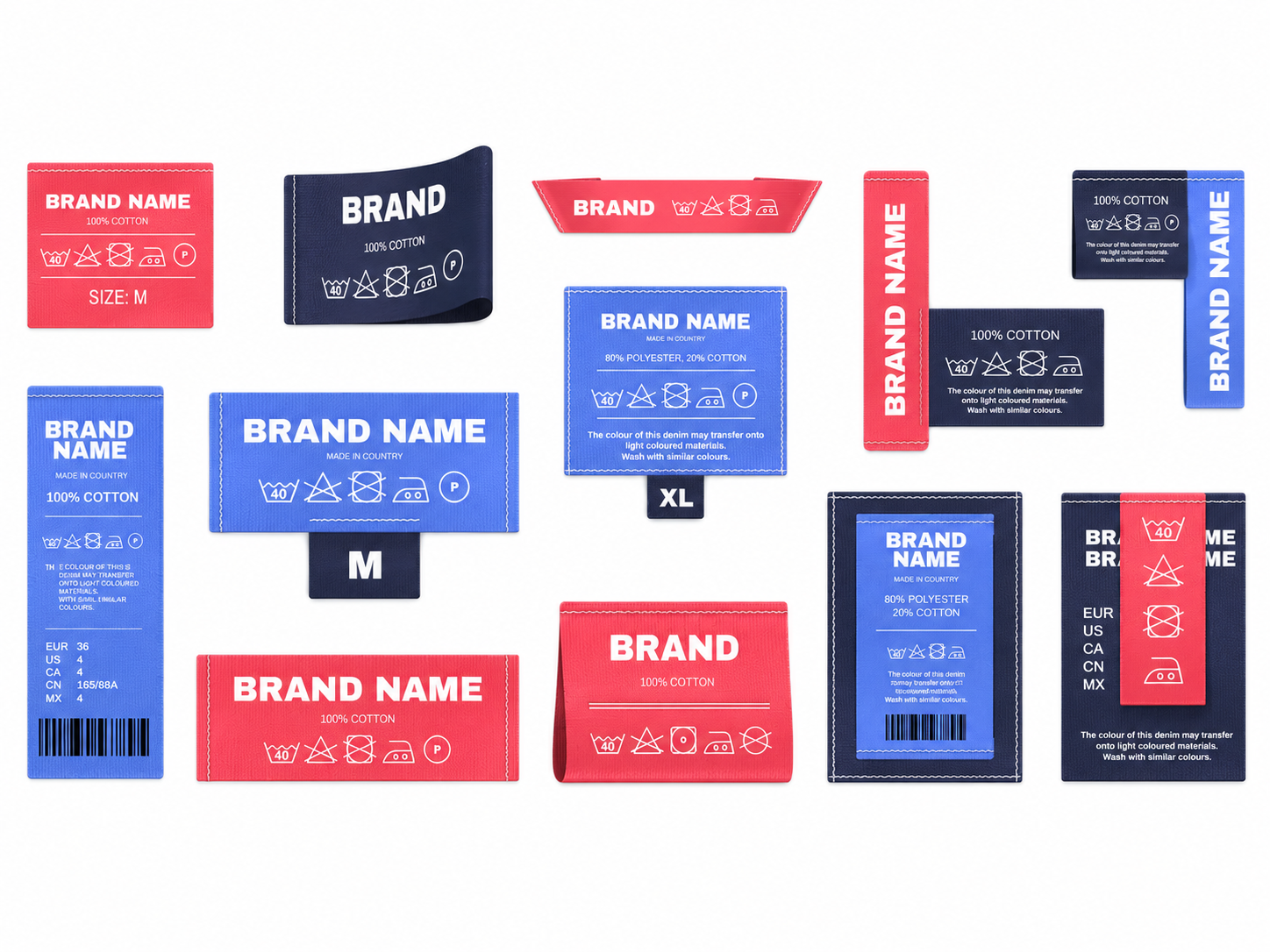
Main Brand Labels
Main labels carry the core brand identity inside or on the garment. Artwork, dimensions, placement, color and attachment method should be confirmed together with garment construction so the label fits the available seam or neck area and remains visually balanced across the size range. If a collection uses the same identity across several styles, the brand file can remain common while attachment details or position are adjusted to suit each garment construction.
- Use for brand name or primary identity.
- Confirm width × height, position and attachment method.
- Review artwork and brand color before sample approval.
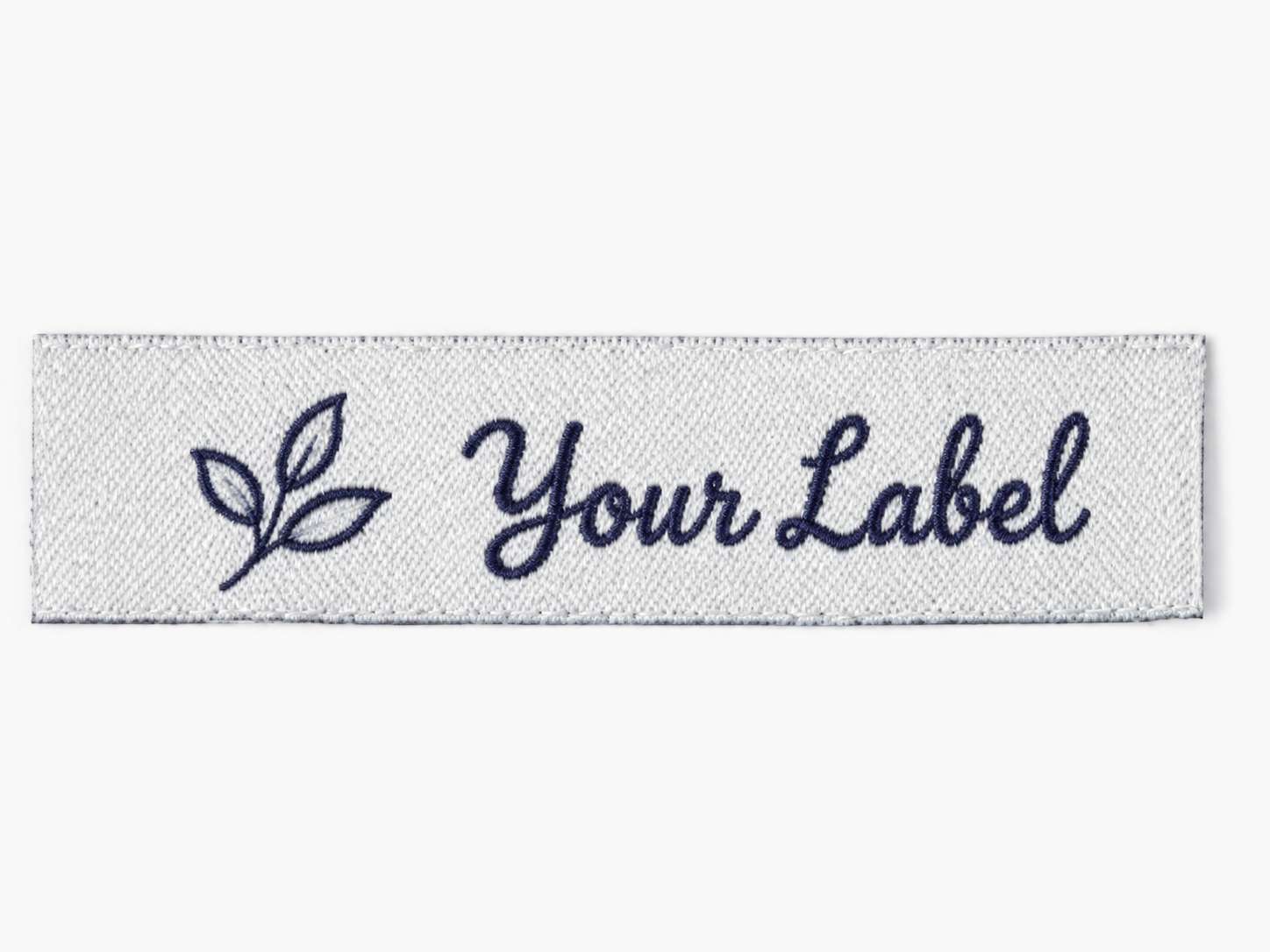
Woven Labels
Woven labels can be arranged for projects requiring a durable woven brand presentation. Leadshow does not claim all woven labels are produced in-house. Structure, thread appearance, edge finish, fold or attachment method, supplier MOQ and timing need review according to the approved design and garment application. A review should also consider how much visual detail the final woven size can carry and whether the selected fold or edge treatment works with the intended seam or neck construction.
- Available by arrangement.
- Supplier MOQ may be separate from garment MOQ.
- Physical sample approval is recommended when detail or hand feel is important.
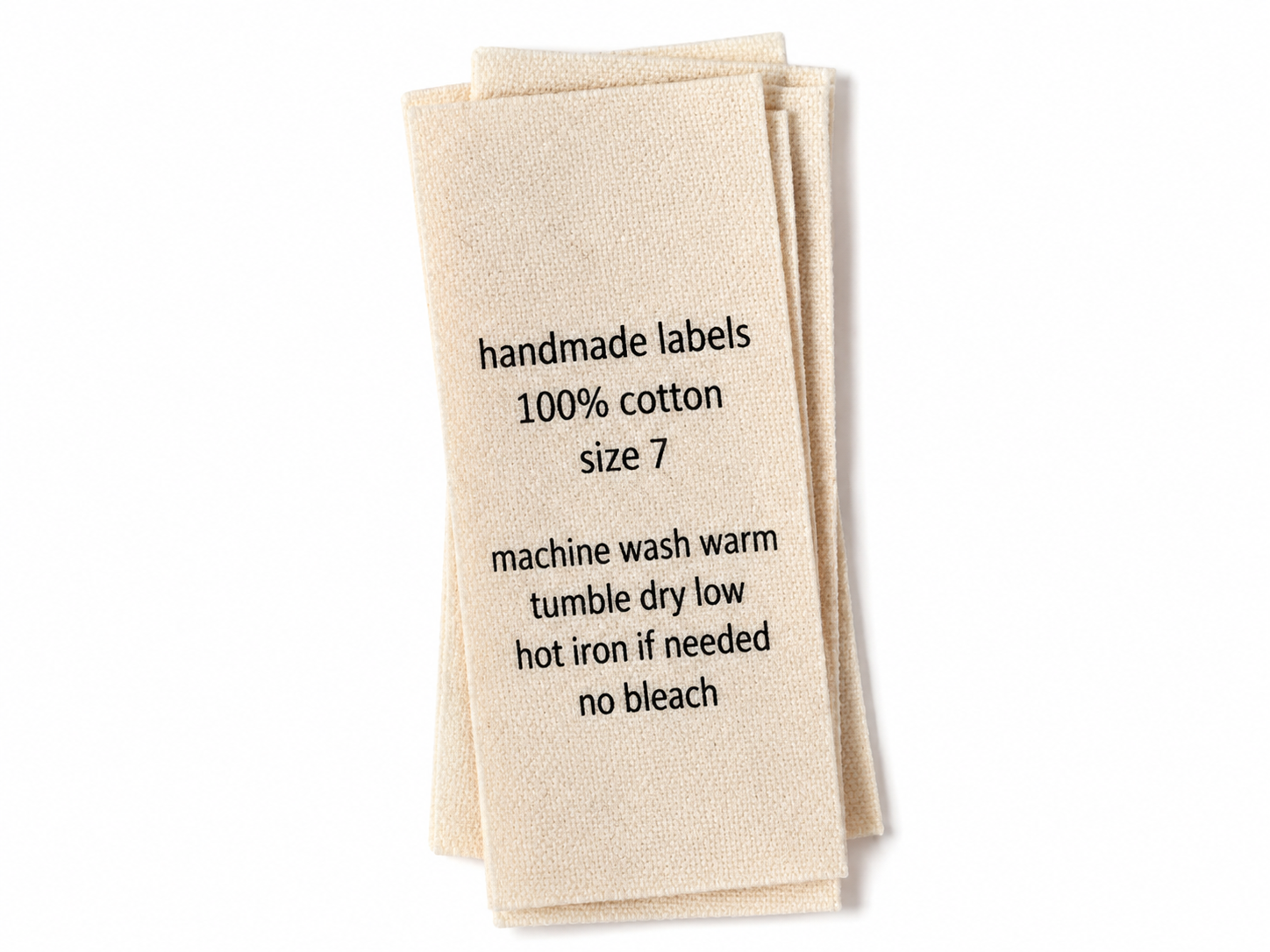
Printed Care Labels
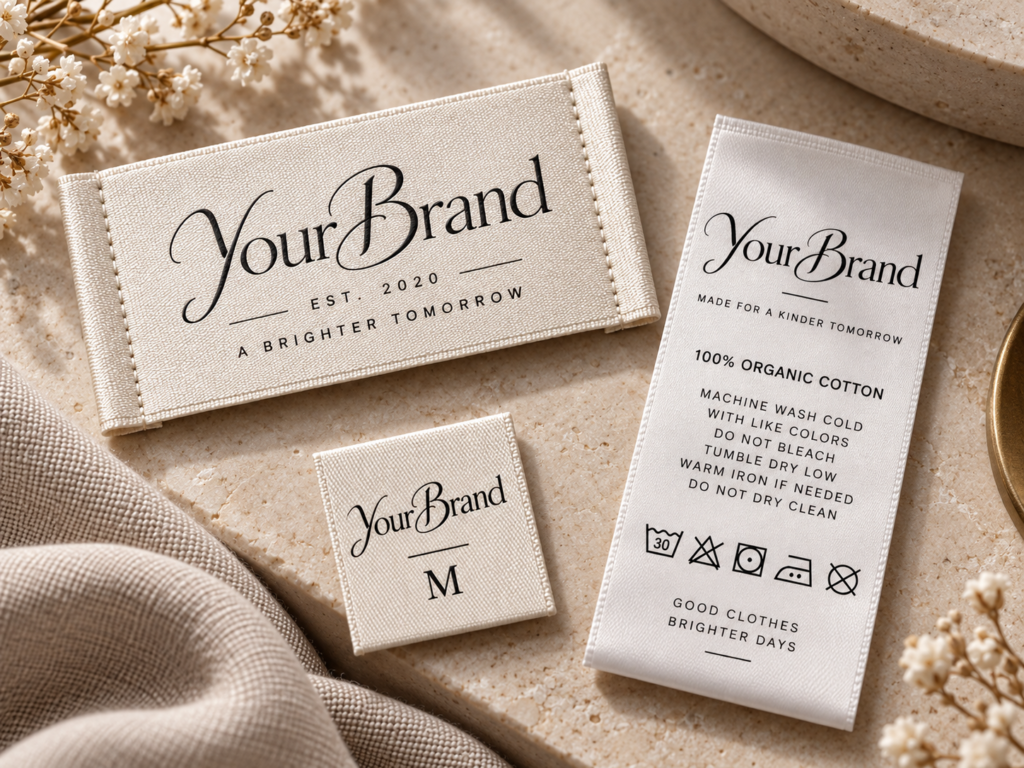
Printed care labels can carry fiber composition, care instructions, size, country of origin, style or other approved information. Content density, language versions, label dimensions, readability and placement should be planned before bulk production. Legal or regulatory wording remains subject to the brand or importer and the destination market. Long multilingual content may require a larger label or a revised layout, so information volume should be confirmed before physical size and placement are frozen.
- Suitable for care and product information.
- Multi-language versions can be coordinated.
- Content must be approved before production.
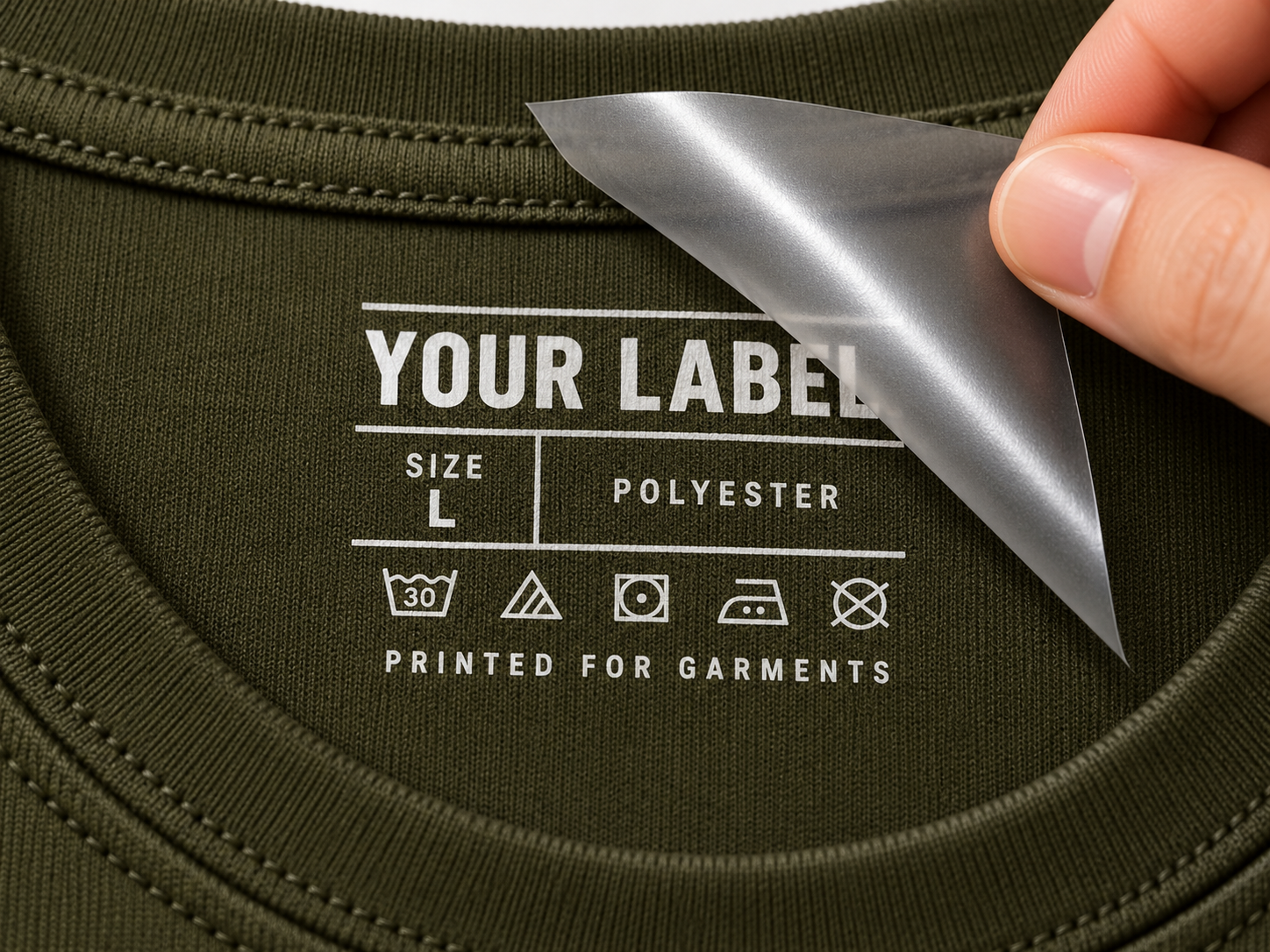
Heat-Transfer Labels
Heat-transfer labels can be evaluated where the fabric, location and garment construction are compatible. Leadshow has confirmed heat-transfer label equipment, but suitability depends on material response, application settings, label size and wash requirements. A sample should establish the approved appearance before bulk application. Position should be tested on the intended fabric panel because stretch, coating, surface texture and nearby seams can change the result even when the artwork itself is unchanged.
- Useful for selected main, size or care labels.
- Subject to fabric and construction compatibility.
- Permanent or wash-proof claims require supporting evidence.
Custom Size Labels
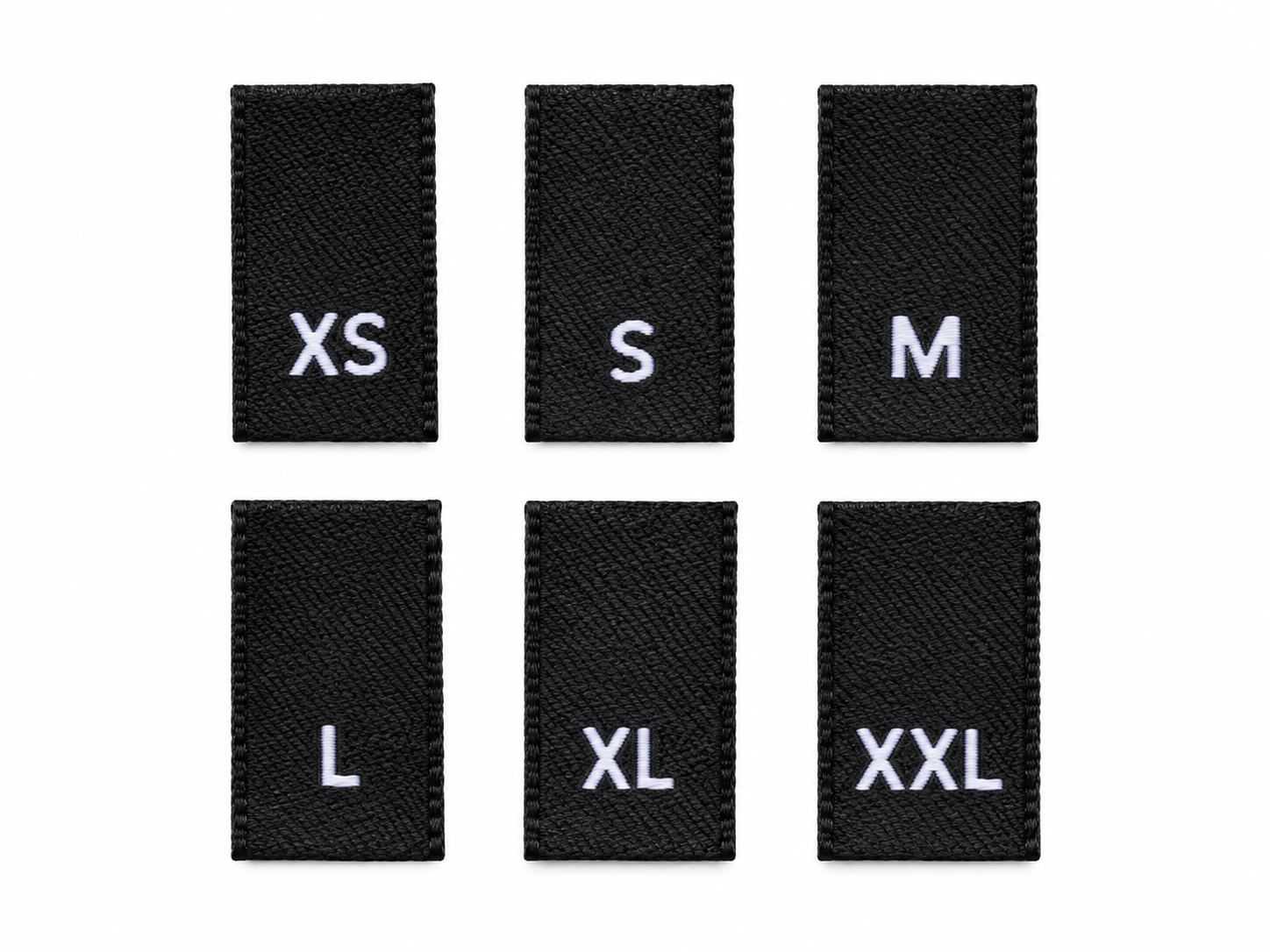
Size labels help distinguish the approved size system at garment level. They may be separate labels or integrated with another approved label format, depending on the design. The size matrix must match the garment order, and any regional size conversion should be approved before label files are released. When a line serves more than one market, the approved size system should be explicit so regional conversions are not introduced informally at the labeling stage.
- Match the approved size chart and SKU matrix.
- Confirm placement and reading direction.
- Avoid late size-system changes after production files are frozen.
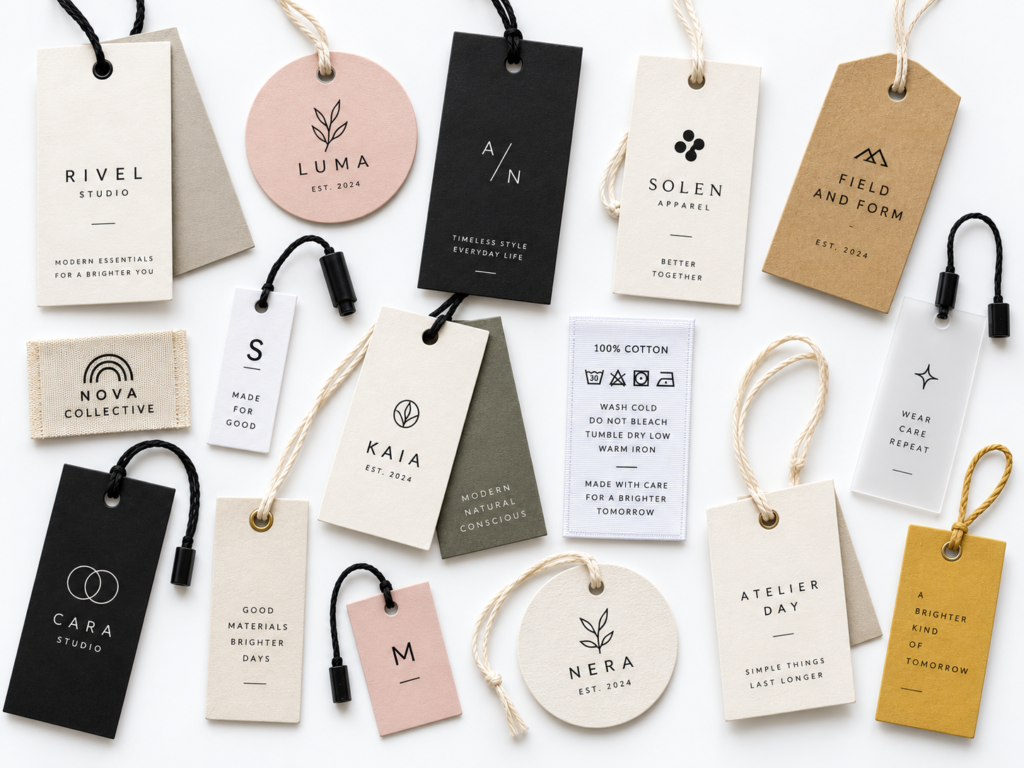
Hangtags
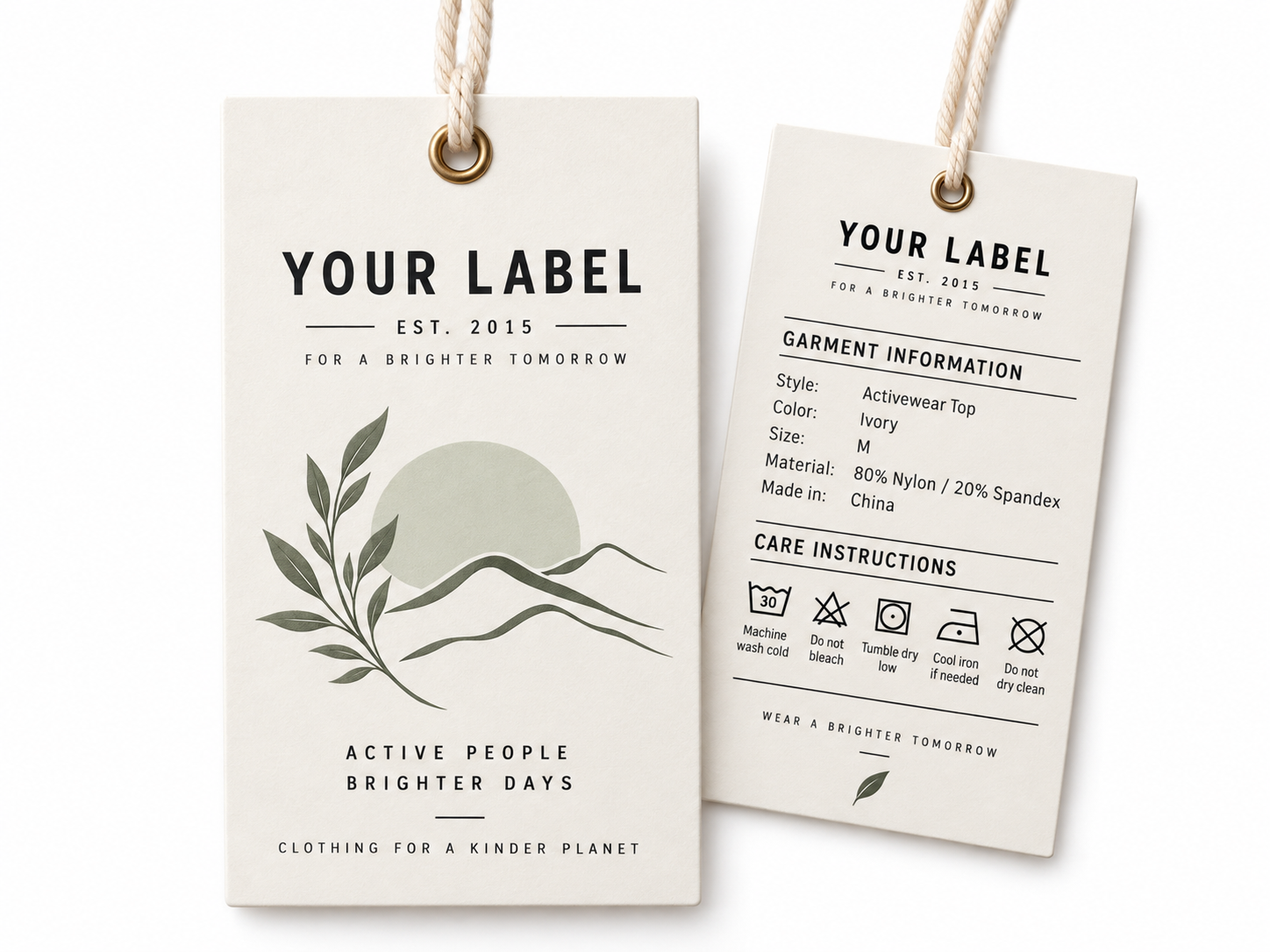
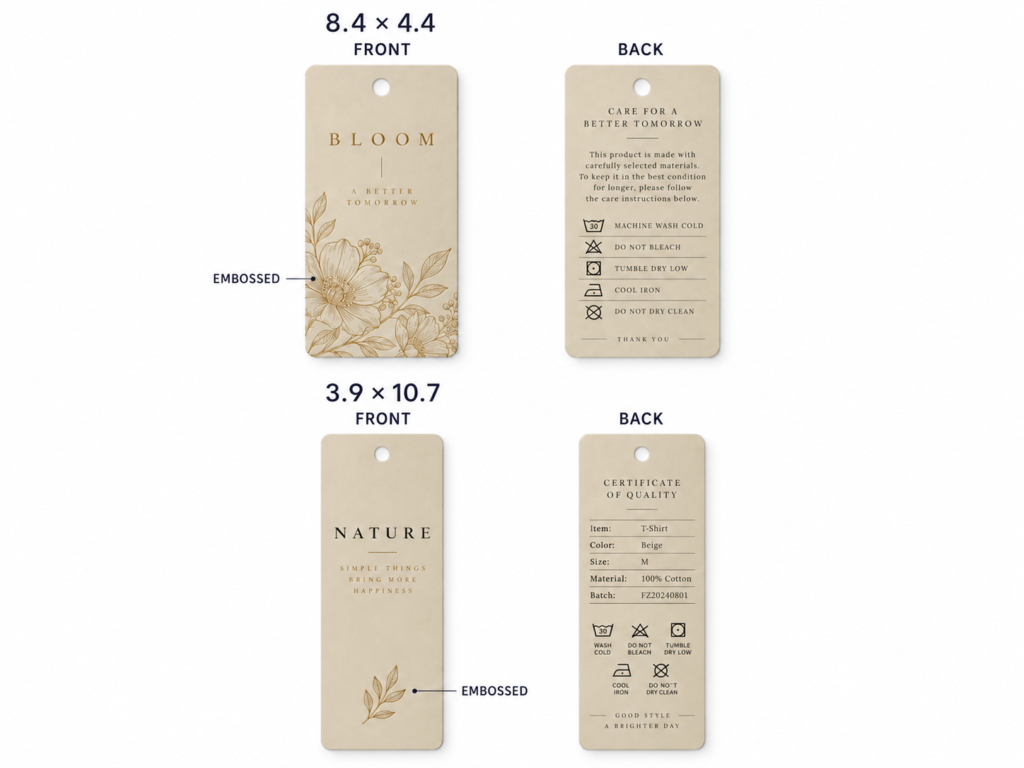
Hangtags add brand, product, pricing or retail information outside the garment. Paper stock, size, artwork, attachment, barcode or SKU content and market version can be reviewed together with packaging. Hangtags should be treated as part of the complete brand file set rather than a last-minute print item. For multi-style collections, shared brand artwork can be combined with style-specific or barcode-specific versions, provided every variant is linked to the correct SKU and approved before printing.
- Coordinate with garment and packaging artwork.
- Barcode data should be supplied and approved by the brand.
- Sampling and supplier MOQ are confirmed by project.
Which Custom Clothing Label Should You Choose?
The right format depends on what the label must communicate, where it sits, how the garment is built and how the brand wants the finished product to feel. Selection should happen before label artwork is frozen.
Label Type
Best Used For
Key Inputs
Garment Consideration
Approval
Main brand label
Primary brand identity
Logo, dimensions, colors, placement
Available neck or seam area; attachment method
Artwork + sample
Woven label
Durable woven branding
Artwork, size, fold/finish, supplier option
Sew-in position and seam allowance
Physical sample recommended
Printed care label
Care, composition and product information
Approved text, languages, size, material
Readability, comfort and placement
Content + sample
Heat-transfer label
Selected main, size or care applications
Artwork, size, material, placement
Fabric heat compatibility and wash requirement
Application sample
Size label
Garment size identification
Size matrix and market system
Placement and relationship to main/care label
Size matrix approval
Hangtag
Retail and brand communication
Artwork, card size, attachment, barcode/SKU
Attachment point and packed presentation
Artwork + packaging sample
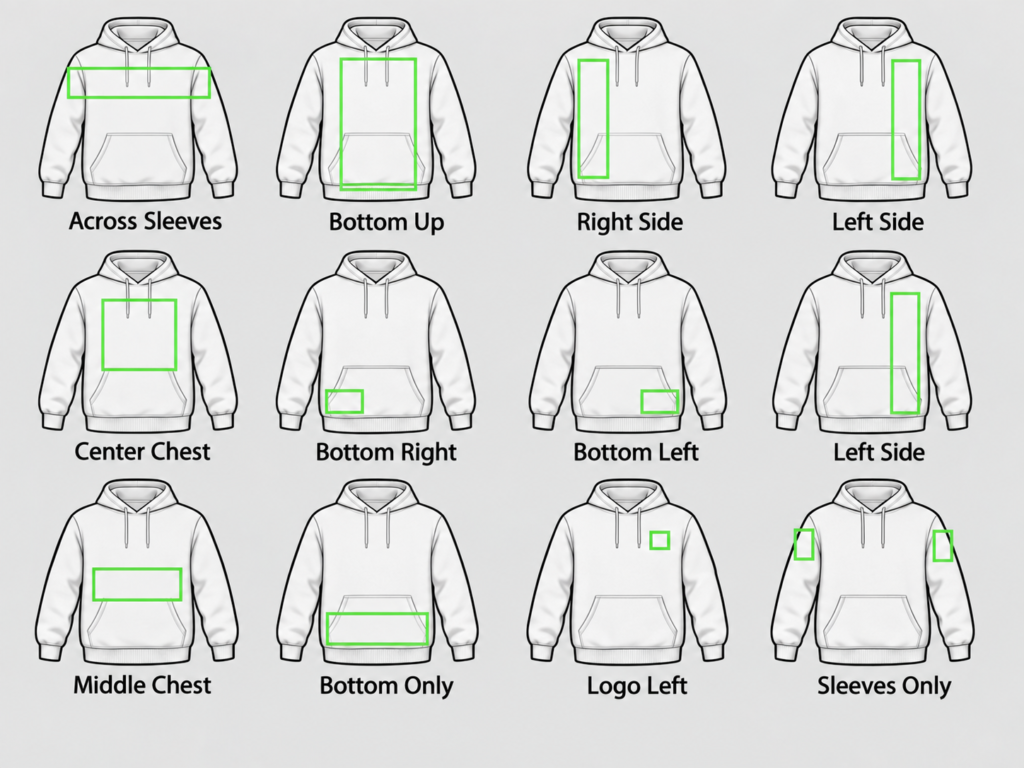
Where Clothing Labels Belong on the Garment
Placement changes both appearance and execution. Brand, size and care information should be assigned to clear locations before sampling so sewing, heat application, SKU identification and packaging remain aligned with the approved garment.
Permanent Internal Labels for Brand, Size and Care
Main brand labels, size labels and care labels usually serve different jobs, even when two functions are combined into one approved construction. The main label carries identity; the size label distinguishes the size system; the care label carries approved product information such as composition, care instructions, country of origin, style or other required text. Placement should be defined in the tech pack or label specification rather than left to the sewing line. Neck seams, side seams, waist areas and other internal positions differ in available space, skin contact and construction. A label that is too wide for a seam can twist or sit unevenly, while a label placed too close to a high-contact area may affect comfort.
Text density can also force a larger care label, which may change the intended location. During sample review, product teams should confirm label dimensions, orientation, attachment points and the relationship between main, size and care information. Where several sizes share one main-label design, the size label still needs a clear matrix linked to the order. Any multi-language or market-specific care version should carry an identifiable file version so the right content is applied to the right SKU. For programs using a separate main label and size label, the two pieces should be reviewed together so the brand presentation remains balanced and the size can be found quickly. The same logic applies to care-label placement: information should remain readable without interfering with comfort, seam performance or the intended interior appearance.
Heat-Transfer Labels for Selected Fabric and Neck Applications
Heat-transfer labels can reduce the need for a sewn-in label in selected locations, but the application must be evaluated against the garment material and construction. Fabric composition, surface texture, stretch, thickness and heat sensitivity all affect the result. A label that looks correct on a flat test piece may behave differently when applied near a seam, on a highly elastic panel or on a fabric with a special surface treatment. Leadshow has confirmed heat-transfer label equipment, allowing selected main, size and care applications to be reviewed within garment development. The approved file should define label dimensions, position, color and orientation, while the sample establishes the actual visual result on the intended garment.
Wash requirements or durability claims should not be assumed from equipment alone; supporting tests may be needed where a specific performance claim is required. Bulk application should follow the approved sample and confirmed production settings, with position and appearance checked according to the project quality plan. The physical position should also be checked after the garment is worn or stretched where relevant, because visual distortion can occur even when adhesion is acceptable. If a new fabric or finish is introduced after approval, the application should be reviewed again rather than assuming the previous setting will transfer unchanged. Brand teams may also choose heat transfer for one product and a sewn label for another within the same collection; the decision can be documented by style so production teams know which method applies.

Hangtags, Packaging Labels and Carton Identification Beyond the Garment
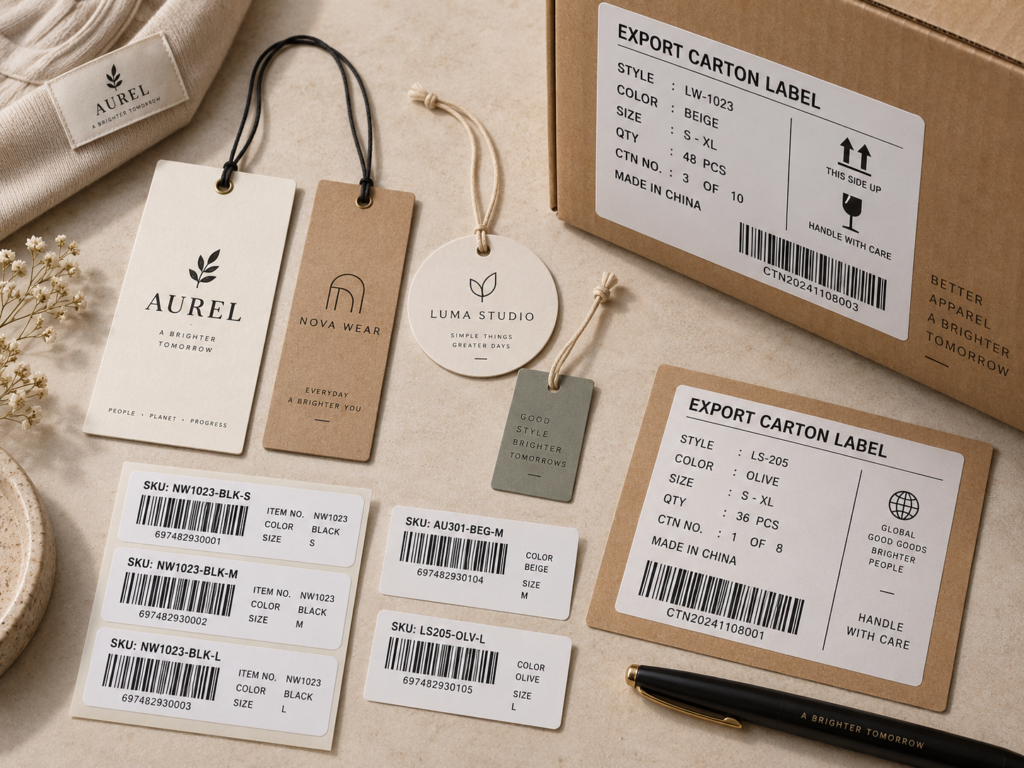
Brand information continues after the permanent garment labels. Hangtags can communicate brand or retail information, while individual bags, paper cards, stickers and cartons may carry SKU, size, barcode or handling data. These items should be planned as one identification system. The hangtag must match the garment style and market version; the barcode must match the SKU; the outer bag label must identify the packed product; and carton marks need to align with the packing list and order instructions. A mismatch at any level can create receiving, distribution or reorder confusion even when the garment itself is correct. Leadshow can coordinate approved hangtags, barcodes, individual packaging and carton markings as part of an apparel program.
Barcode data and legal text should come from approved brand or importer files. For multi-SKU orders, the strongest workflow links style, color, size, label version, barcode and packaging version before bulk packing starts. Sensitive commercial barcodes or brand files should not be displayed publicly without authorization. Retail programs can add another layer when hangtag content, price tickets or packaging labels differ by market. In those cases, the variant should be linked to the same SKU matrix used for garment size and color. Carton-level information should then follow the packing structure rather than introducing a separate naming system. Clear handoff files reduce the risk of a correct garment being paired with the wrong retail identity during final preparation.
What Brand Files Start an Accurate Label Review?
Accurate label work starts with usable files rather than a logo alone. A complete review connects artwork, dimensions, placement, care content, size and SKU information, target market and order quantity before sampling begins.
Logo Artwork
Provide vector artwork where available, or a high-resolution file that can be reviewed for production. Fine details, small text and narrow lines may need adjustment depending on label type and final size. Brand ownership or authorization should be clear before protected artwork moves into production. Where several products share the same logo, identify whether one master artwork applies to all styles or whether size, color or placement variations are required by product.
- Preferred: vector or production-ready artwork.
- Include logo orientation and approved proportions.
- Third-party brand or protected artwork requires appropriate authorization.
Dimensions and Placement
State label width × height in millimeters and identify the intended garment position. If dimensions are not finalized, provide the garment area and desired visual balance so the specification can be reviewed during sample development. Placement should match seam, neck, waist or packaging construction. Include seam references or distance from a clear construction point when placement accuracy matters, especially for neck labels, side-seam care labels or exterior branding details. Add a reference photo when the written position could be interpreted more than one way.
- Width × height in mm.
- Garment position or packaging location.
- Orientation, fold or attachment requirement where applicable.
Brand Colors
Provide approved color references for logo and label artwork. A digital color value alone may not predict the exact appearance on woven, printed, paper or heat-transfer materials. Where color is brand-critical, approval should rely on the selected material and physical sample rather than screen appearance. If the label will use more than one material family, note which brand colors are visually critical and whether physical color approval is required before bulk release.
- Pantone or approved brand reference where available.
- Identify colors that must remain consistent across labels and packaging.
- Allow for material-dependent visual differences.
Care Content
Supply the approved fiber composition, care instructions, country-of-origin information, size language and any other required product text. Leadshow can coordinate application and version control, but the brand or importer remains responsible for confirming applicable legal content for the destination market. Long care text may affect label dimensions, fold and placement, so final wording should be available early enough to avoid resizing the label after garment sampling. Identify any market-specific variant so language or origin text is not merged into the wrong production file.
- Approved composition and care wording.
- Required language versions.
- Country of origin and other market information.
Size and SKU Matrix
Provide style, color and size combinations together with SKU identifiers when the order includes multiple variants. The matrix helps prevent the correct label artwork from being paired with the wrong size, barcode or packaging version. Version clarity becomes more important as the number of variants increases. For regional programs, identify whether the same garment size needs different market labeling so each version can be mapped before production and packing. A simple spreadsheet is usually sufficient if each line clearly identifies style, color, size and version.
- Style × color × size breakdown.
- SKU or internal product codes.
- Barcode file references where applicable.
Market and Quantity
State the destination market, sales channel and expected garment quantity per style and color. Garment MOQ, label supplier MOQ, packaging MOQ and timing are separate commercial factors. Early quantity information also helps determine how many label versions, languages or packaging variants must be managed. If one design serves several regions, split quantities by market version so care labels, barcodes, hangtags and packaging can be reviewed against the correct allocation. Quantity splits also help determine whether several low-volume versions create separate supplier minimums.
- Destination market or regional version.
- Quantity per design, color and size.
- Target schedule and channel requirements.
Care Label Content and Market Information
Care labels combine product facts, brand decisions and destination-market requirements. Leadshow can coordinate approved content and application, while the brand or importer retains responsibility for confirming the applicable legal wording and market rules.
Information Field
Typical Project Input
Why It Matters
Approval Responsibility
Fiber composition
Approved material composition for the garment
Drives content accuracy and market labeling review
Brand / importer
Care instructions
Approved wash, dry, iron or other care wording/symbols
Guides garment care and product communication
Brand / importer
Size system
XS–XL, numeric sizing, regional size system, or approved matrix
Must match garment and SKU
Brand / product team
Country of origin
Approved origin wording for the finished garment
May be required by destination-market rules
Brand / importer
Style / product code
Approved style number or internal product reference
Links label content to the correct garment
Brand / product team
Languages
Approved language versions by market
Prevents mixed or incomplete regional information
Brand / importer
Barcode / SKU
Customer-provided and approved data where applicable
Connects product, label and packaging records
Brand / retail team
Destination market
Market or region where the garment will be sold
Determines which information needs review
Brand / importer
From Artwork to an Approved Label Sample
A controlled sample path reduces late changes. Timing is confirmed after artwork, material, supplier and application requirements are understood; no single fixed sample schedule can represent every label and garment combination.
Brand Files Received
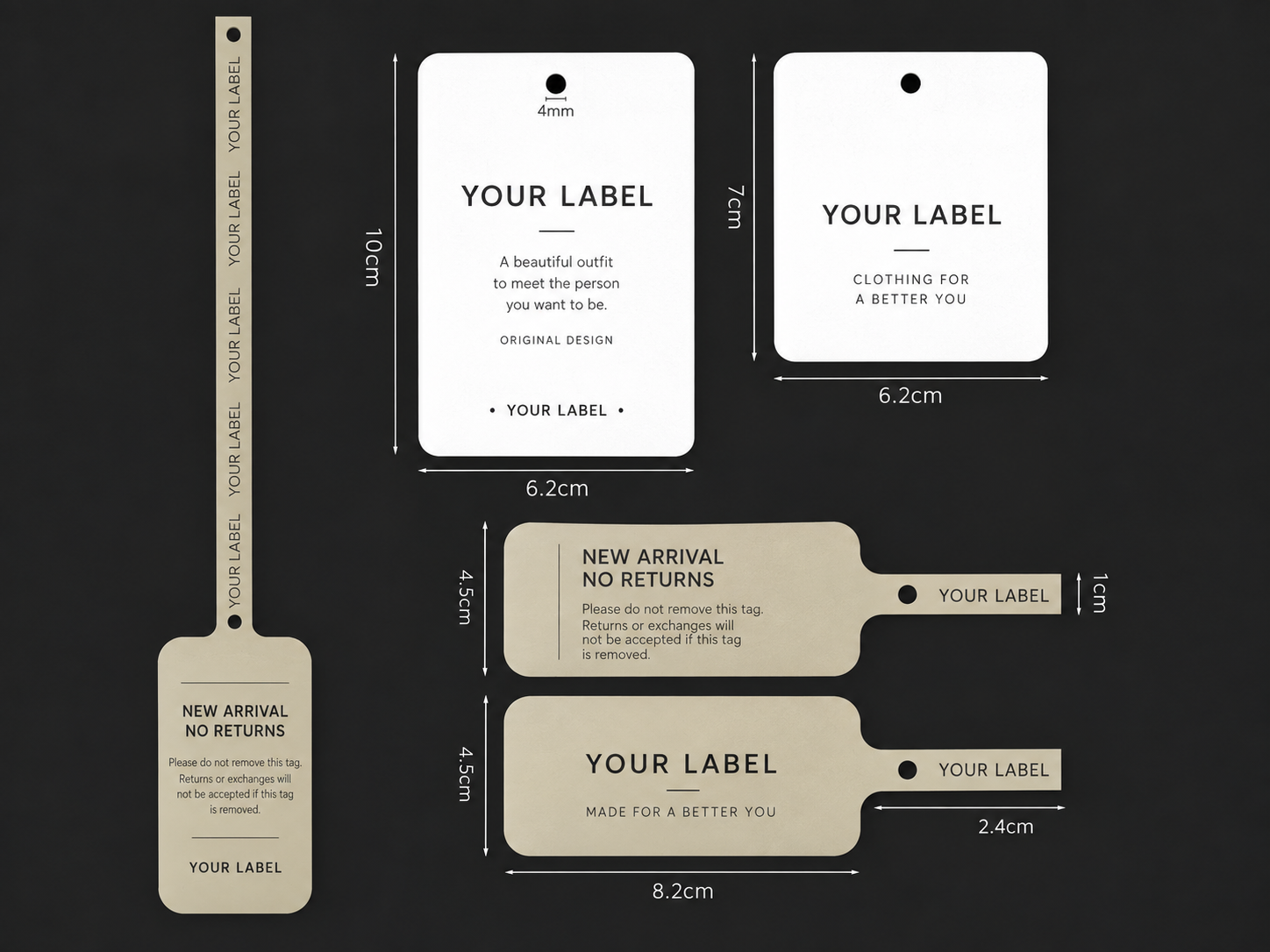
The project starts with the available brand files: artwork, dimensions, placement, care content, size system, SKU matrix, quantity and destination market. Missing information is identified early so a label is not sampled against an incomplete garment brief. The team can then separate confirmed information from open questions and avoid treating an early visual file as a final production instruction. Quantity and market splits are also captured before sampling so later commercial review is based on the same project scope.
Specification Review
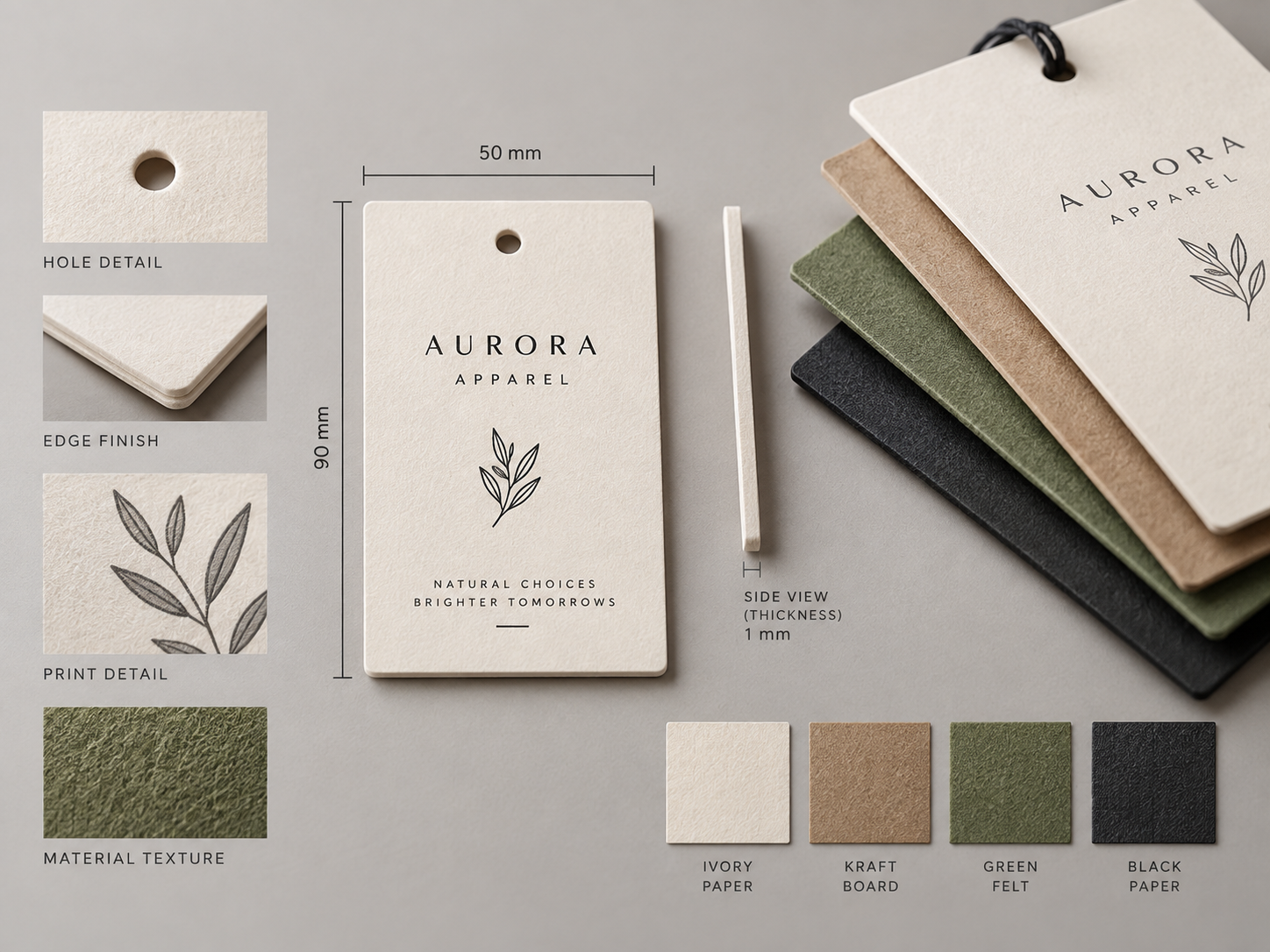
Label type, dimensions, orientation, content density, color references and application method are reviewed against the intended garment. The aim is to convert artwork into an executable label specification rather than relying on a visual file alone. Any conflict between artwork, garment construction, information volume or brand rules can be raised before a physical sample is commissioned. The reviewed specification becomes the reference for supplier inquiries, sampling and later production control.

Material or Supplier Review
Woven labels and other supplier-coordinated items may require material, finish, MOQ and timing review with an external source. Heat-transfer applications are evaluated for fabric compatibility. Supplier conditions are confirmed before final commercial commitments are made. Where a supplier is involved, current availability and minimums are checked again instead of assuming historical conditions still apply. Any change in supplier source or label construction should be visible in the approval trail before bulk release.
Label Sample
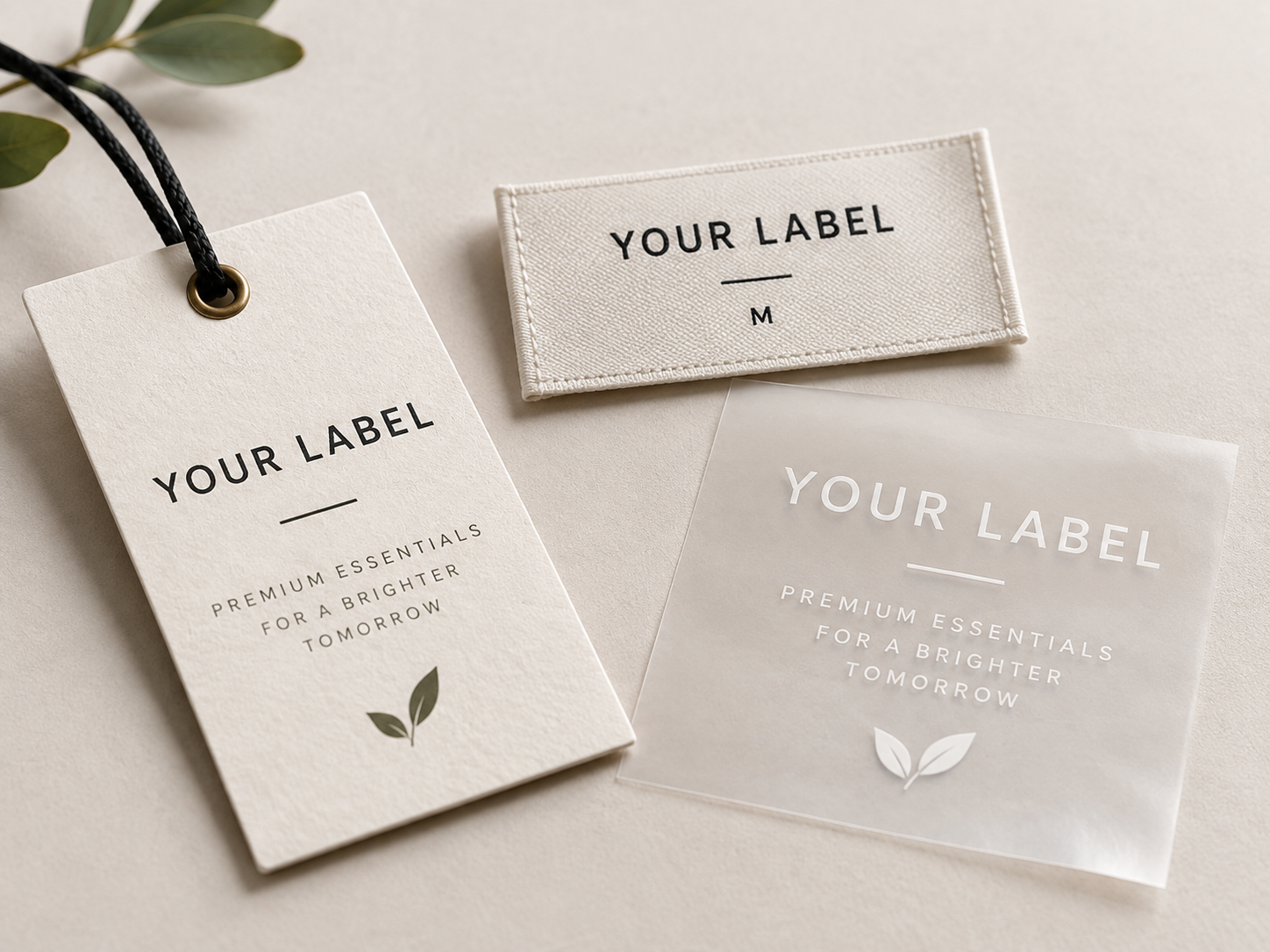
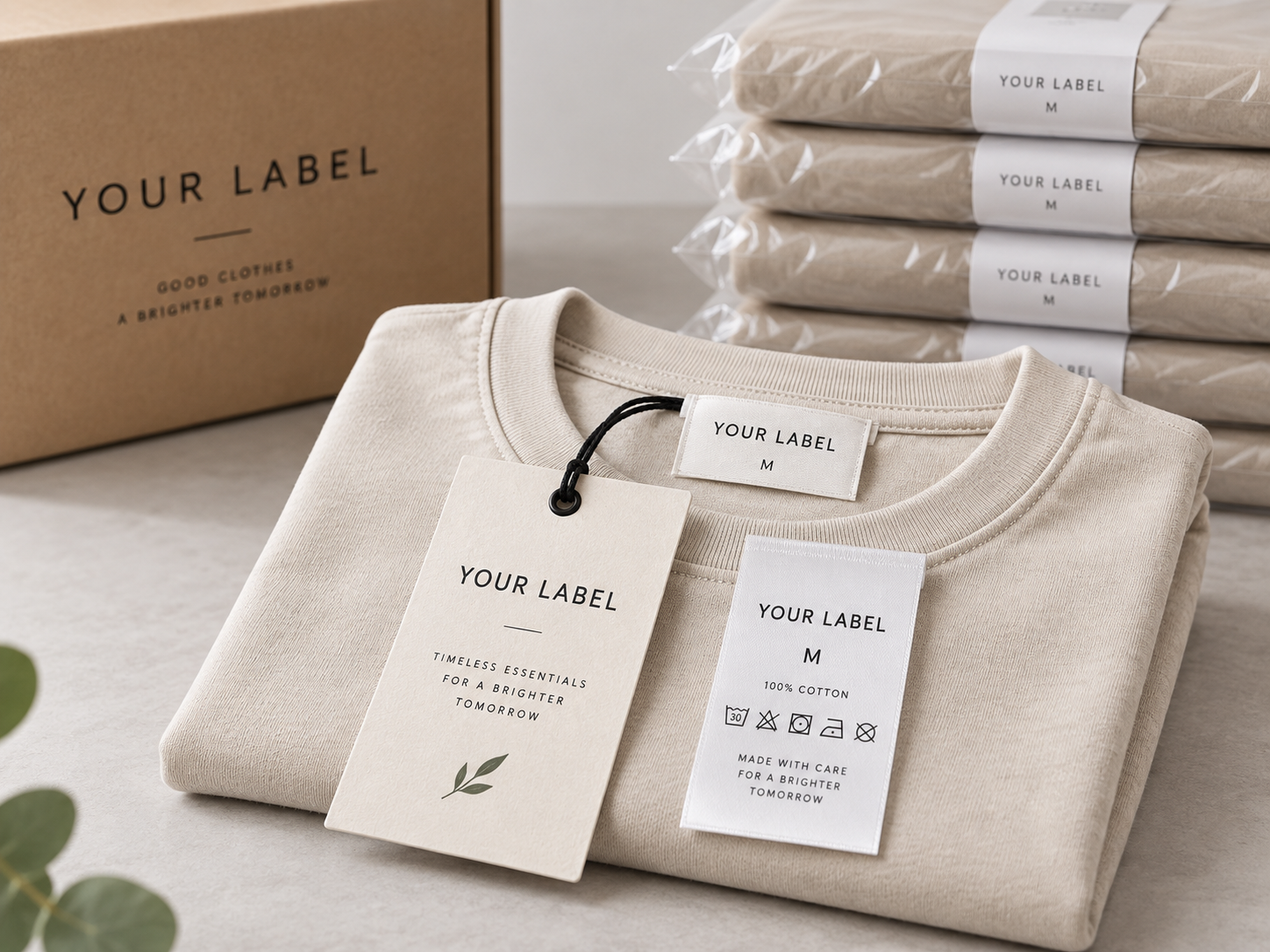
A physical label, print sample or heat-transfer application sample may be prepared according to project needs. The sample should allow review of size, color, readability, material feel, edge or attachment details and overall brand presentation. If color, hand feel or edge finish is brand-critical, approval should rely on the physical result rather than a screen preview alone. Comments should be specific enough to distinguish color, dimension, feel, edge, print, weave or application revisions.
Garment Application Review
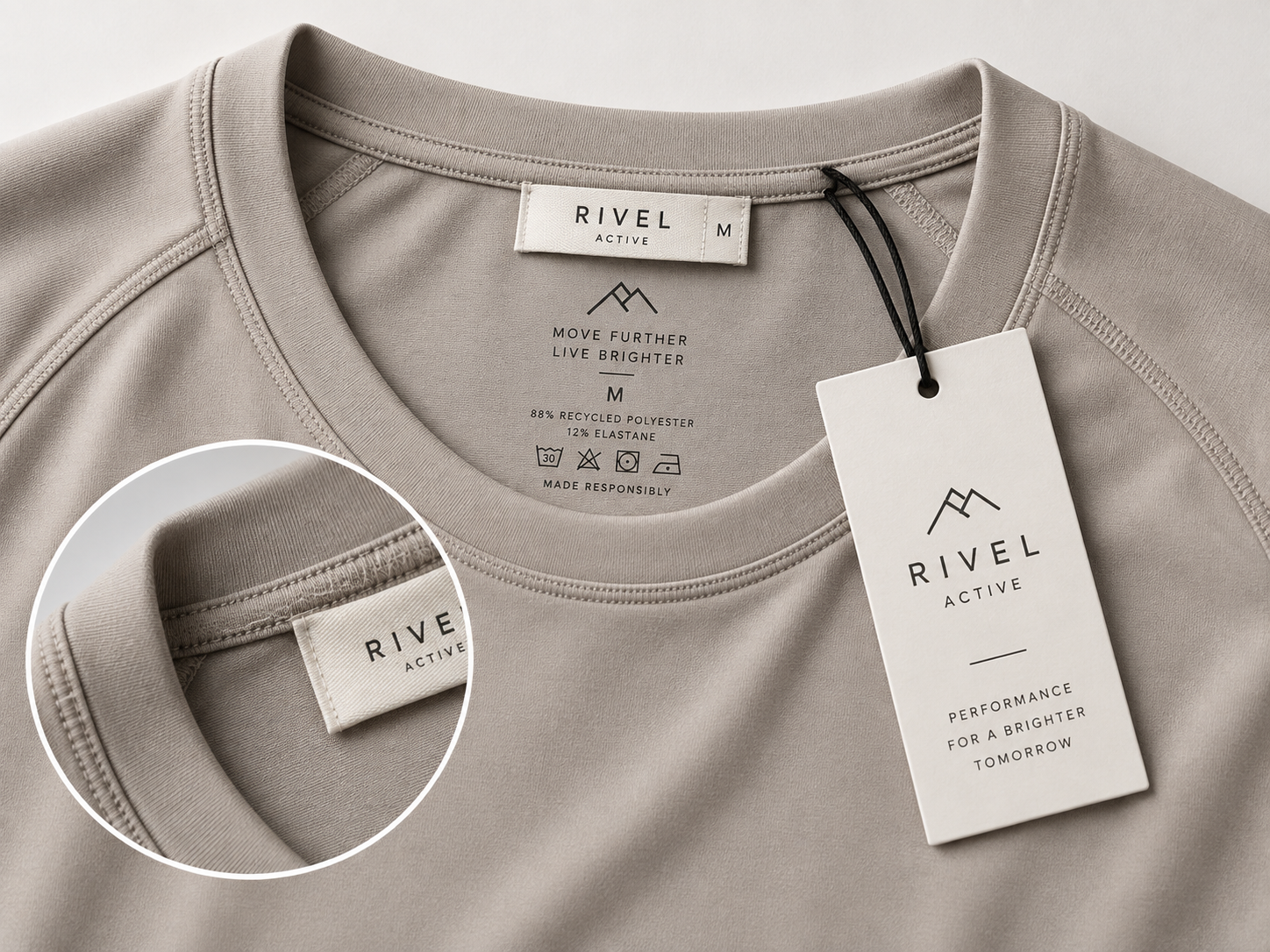
Where label performance depends on garment construction, the approved evaluation should include the actual placement on a development, fit or pre-production garment. Position, orientation, seam interaction, comfort and visual balance can then be checked in context. Comments from the garment sample should be written back into the latest label specification so later production does not rely on verbal memory. The approved result can then be photographed or referenced in the project record for production teams.
Approval for Bulk
Bulk label use should follow approved artwork, label specifications, garment references and version-controlled files. If content, size, placement, material or market information changes after approval, the affected files need another review before mass application or packing. Released files should be easy to identify by production, quality and packing teams, while obsolete versions are removed from active use. Final approval should identify the exact artwork and market version so later reorders know which record was accepted.
Heat-Transfer Label Capability for Suitable Garments
Heat-transfer labels can support selected brand, size and care applications without a traditional sewn-in label. Results depend on material compatibility, application settings, approved artwork and the intended durability requirement.
Confirmed Equipment and Suitable Label Uses
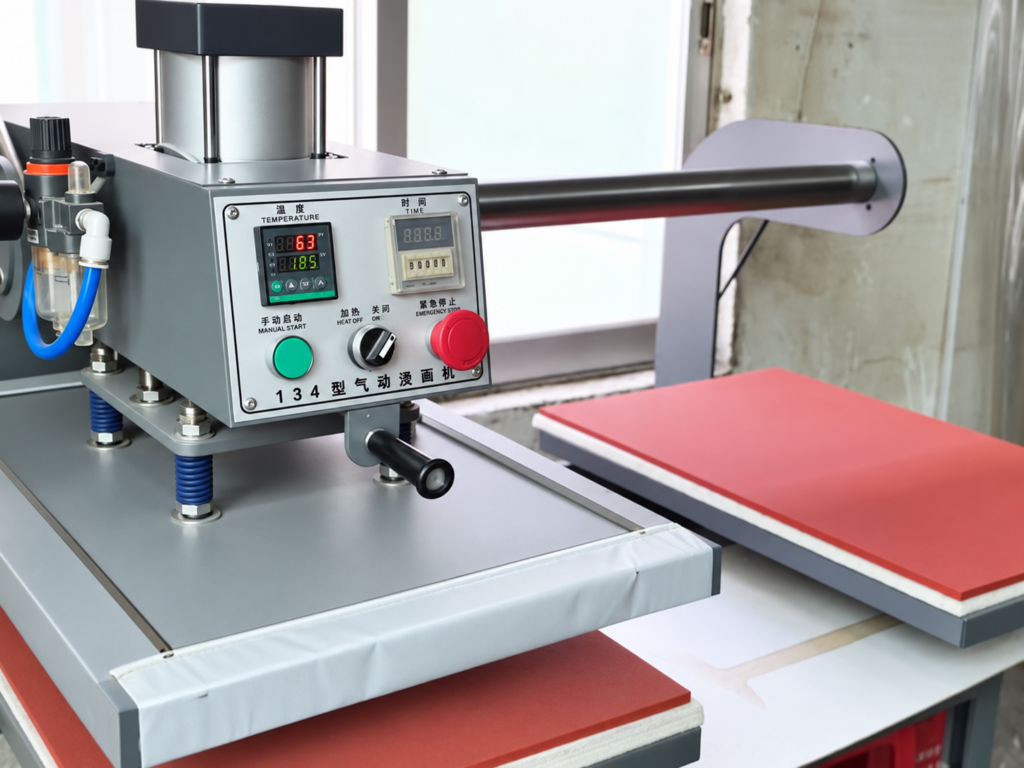
Leadshow has six confirmed dual-station heat-transfer label machines that can support selected Heat Transfer Main Labels, Heat Transfer Care Labels and Heat Transfer Size Labels. The equipment provides a real manufacturing base for integrating heat-applied identification into apparel projects, particularly where a lower-profile internal label is preferred. Equipment availability does not mean every fabric or every location is automatically suitable. Stretch, surface coating, thickness, texture and heat sensitivity can change adhesion and appearance. A thin performance fabric may respond differently from a heavy sweatshirt fabric, and a smooth neck panel may behave differently from a textured or bonded area. Product teams should therefore provide the intended garment, artwork, label dimensions and placement before the application method is finalized.
Where a project calls for a specific wash-life or permanence claim, the requirement should be defined so a suitable material and test path can be considered. The safest commercial statement is capability subject to fabric and construction evaluation, not a universal performance promise. The same equipment can support different artwork sizes and product categories, but process settings still need to be matched to the selected label material and garment substrate. Internal capability is most valuable when the label application can be reviewed together with the garment sample, because the development team can see the actual result rather than evaluating a separate trim in isolation.
What Must Be Checked Before Heat Application
Before a heat-transfer label is approved, several inputs need to align: the garment material, exact placement, label dimensions, colors, orientation, application temperature and pressure, dwell time and any wash or durability requirement. The artwork itself also matters. Very small lettering or dense information may become difficult to read at the requested size, especially on a curved or stretched area. Placement must consider seams and garment elasticity; applying across a seam or onto a highly distorted area can create a result that differs from the flat sample. A useful approval process evaluates the label on the intended garment material rather than relying only on a digital mockup. If the label carries care or size information, readability after application is as important as appearance.
If the garment will undergo testing or repeated laundering, the heat-transfer material and process should be evaluated against the relevant requirement. No statement such as permanent, wash-proof or never peels should be used without supporting evidence for the selected construction. Brand colors should also be evaluated on the actual transfer material because screen colors do not fully predict the applied result. Where a collection uses the same logo across different fabrics, one approved setting should not automatically be copied to every style. Each materially different substrate can justify a short compatibility check before bulk release, especially when surface treatment, stretch or thickness changes.
Approval, Bulk Application and Quality Review
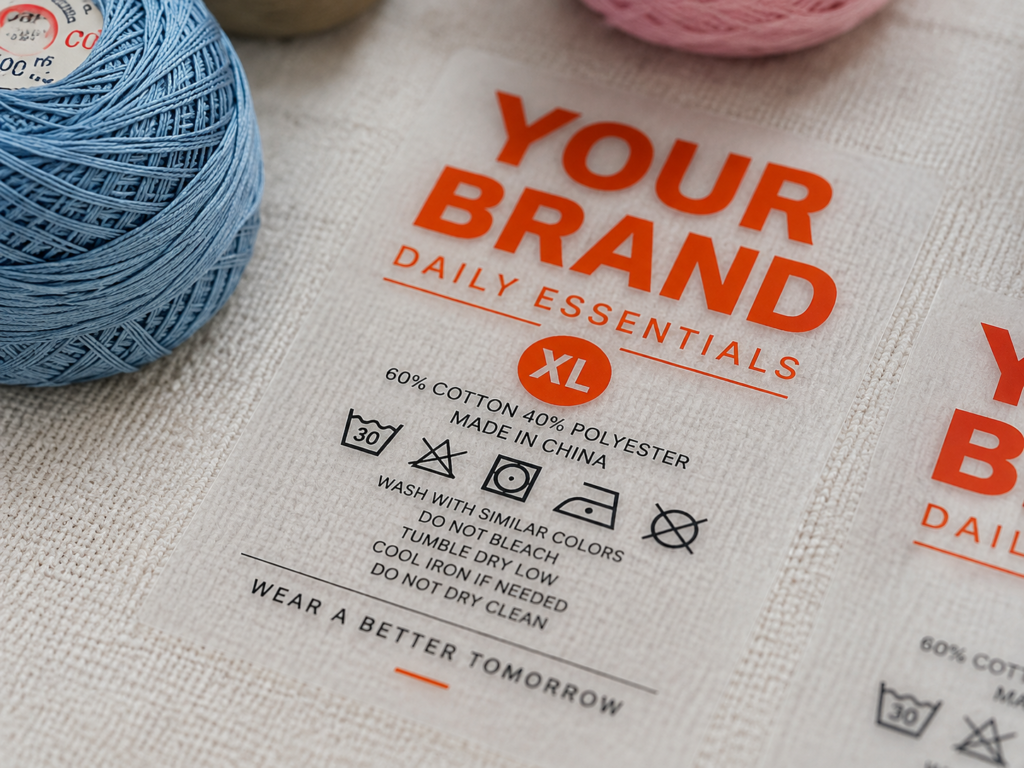
Once the heat-transfer appearance is approved, the file version, label size, location and application method should be frozen before bulk production. Bulk execution can then reference the approved garment or application sample together with the confirmed specifications. Quality checks may include label position, orientation, visual appearance, content, size and adherence, depending on the order standard. Leadshow’s quality function can review labels as part of approved garment and packaging requirements, but the exact inspection scope and acceptance criteria are confirmed by project rather than assumed as a universal 100% inspection rule. Any artwork, size, care-content or garment-material change after approval may require another application check because a change in substrate can alter the result.
For repeat orders, the previous approved files remain useful references, but supplier conditions, material availability and current requirements should still be reconfirmed before a new bulk run is released. If the order includes several styles or size groups, the production file should identify which transfer version belongs to each product and where it is placed. Reorders should compare the current garment material and transfer source with the previous approved reference before repeating settings. Such controls support consistent execution while preserving the factual boundary that adhesion and wash performance depend on the selected materials, process and applicable testing.

How Labels Enter the Garment Manufacturing Workflow
Label accuracy depends on where the information enters the manufacturing workflow. Approved files should connect product development, sampling, bulk production, quality checks and packing instead of being treated as an isolated purchasing task.
Align Label Specifications With the Garment Tech Pack
A strong label workflow starts by linking brand files to the garment specification. The tech pack or project file should identify label type, dimensions, placement, content, orientation and attachment method, together with any style- or market-specific version. Main labels need to fit the available construction; size labels need to match the approved size system; care labels need to carry approved information; heat-transfer labels need a compatible substrate; and hangtags need an approved attachment point. If the garment design changes, the label plan may also need adjustment. A new neck construction can change the available label width. A new fabric can change heat-transfer behavior. A revised size range can add label versions. Integrating those decisions early helps avoid a common failure mode: garments reach bulk production while label files are still being revised separately.
Leadshow can coordinate labels as part of apparel development, which makes the label specification part of the same product record used for sampling and manufacturing. The objective is clear execution, not simply obtaining a printed or woven trim. The label file should also state whether the item is supplied externally, applied by heat, sewn into a seam or attached during packing. That simple classification clarifies ownership of the next step and makes it easier to estimate supplier MOQ, sampling and production timing. When a label change affects the garment structure, both records should be updated together so the approved sample and the production specification do not diverge.
Confirm Label Placement During Sample Development
Sample development is the right stage to verify how the label looks and behaves on the actual garment. A digital artwork approval cannot show whether a main label sits squarely in the neck, whether a care label feels too bulky at the side seam, whether a size label is visible in the intended position or whether a heat-transfer mark fits the available panel. During garment sampling, the label can be reviewed together with fit, fabric, seam construction and branding. For a multi-size program, product teams should also check whether the chosen label size and position remain appropriate across the size range. Where a care label has multiple language versions, the dimensions may change because of text volume. Where hangtags or external labels are used, the attachment point should not damage or distort the garment.
The approved sample should make the expected position and appearance easy to understand before bulk production. Any sample comment affecting label content, dimensions or location needs to be reflected in the latest project file. The same sample review can check whether the label remains visually centered after the garment is worn, folded or stretched. If the care label is long, teams can evaluate whether a different fold, material or position would improve the interior result without sacrificing readability. Written sample comments should identify the exact change and the affected file version, keeping the label decision traceable when the garment moves into later approval stages.
Freeze Approved Versions Before Bulk Production
Bulk production creates a much higher risk of version confusion because several styles, colors, sizes and market variants may be active at the same time. Before bulk release, the latest label artwork, care content, size matrix, SKU mapping, barcode files and packaging artwork should be frozen or clearly versioned. The production and packing teams need a single approved source rather than parallel files from different email threads. For woven or externally sourced labels, supplier production should follow the latest approved file. For heat-transfer labels, bulk application should reference the approved result and confirmed settings. If a brand updates care text or changes a barcode after label production has started, the affected quantity and production stage need to be identified before the change is accepted.
Version control reduces wrong-label and mixed-SKU risk, but it does not eliminate the need for line-level and packing-level checks. Clear files, clear approvals and clear release timing remain the foundation. A release checklist can record which artwork, care file, size matrix and packaging version is active, along with any supplier approval reference. Such discipline becomes more valuable when several purchase orders or market versions overlap. The objective is not to create administrative complexity; it is to make the production team confident that one clearly approved set of instructions controls the order at the moment labels and packaging are made.
Check Labels Together With Garment and Packaging
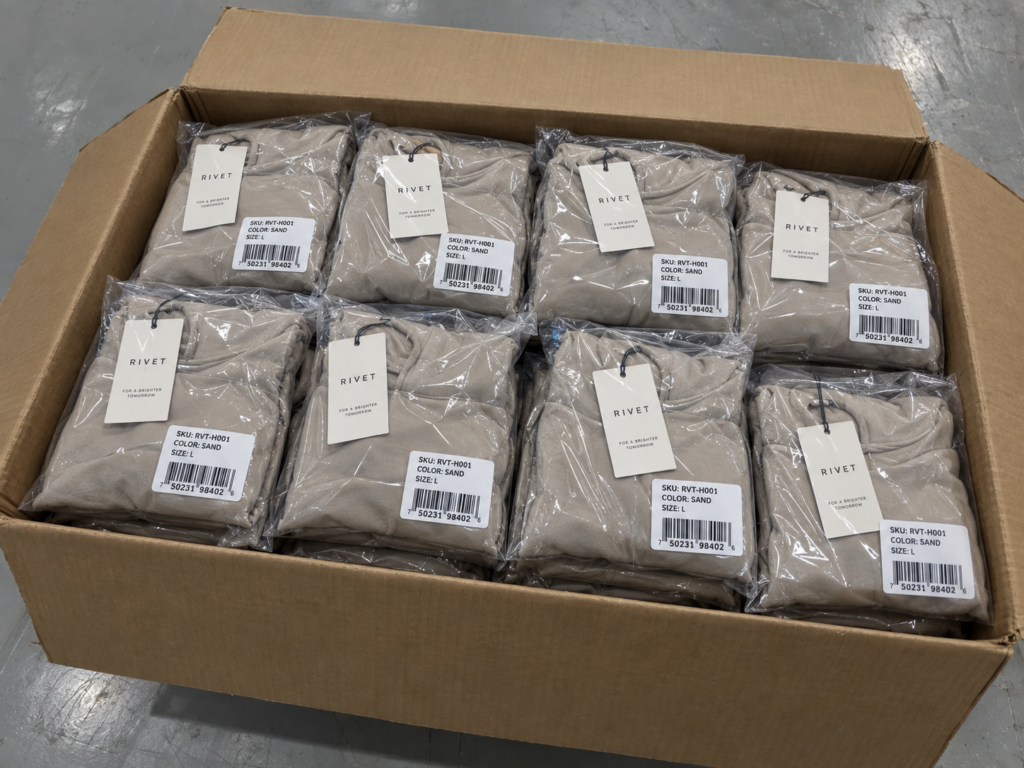
Final label accuracy is not only a label question. The correct main label can still be paired with the wrong size label; the correct garment can still enter the wrong bag; the correct bag can still carry the wrong barcode. A useful quality review follows the chain from garment identity to label, SKU and packaging. Depending on the project, checks may cover label content, dimensions, orientation, placement, stitching or heat application, size identification, hangtag attachment, barcode data and packaging marks. Leadshow can coordinate garment, label and packaging requirements against approved project files, and its warehousing and logistics functions support SKU sorting, labeling, packing and carton preparation.
Inspection scope, sampling method and acceptance criteria remain project-specific. The goal is to make each packed unit understandable and traceable to the approved order structure without making unsupported claims about zero errors or universal full inspection. When a discrepancy is identified, the record should show whether the issue originates from artwork, label production, garment application, SKU allocation or packing. That distinction helps the relevant team correct the right stage instead of treating every labeling problem as the same defect. Clear cause and disposition records also improve the next repeat order by showing which part of the file set needs special attention.
SKU, Barcode and Label Version Control
Multi-SKU apparel needs a simple control matrix linking style, color, size, labels, barcode and packaging. The illustration below shows how project files can be structured before labels and packing materials are released.
Style
Color
Size
SKU
Main/Size Label
Care Label
Barcode File
Packaging Version
Status
STYLE-A
Black
S
A-BLK-S
L-A / S
C-US-01
BC-A-BLK-S
PKG-US-01
Approved
STYLE-A
Black
M
A-BLK-M
L-A / M
C-US-01
BC-A-BLK-M
PKG-US-01
Approved
STYLE-A
Stone
S
A-STN-S
L-A / S
C-US-01
BC-A-BLK-S
PKG-US-01
Approved
STYLE-B
Black
S
B-BLK-S
L-B / S
C-CA-02
BC-B-BLK-S
PKG-CA-02
Review
STYLE-B
Black
M
B-BLK-M
L-B / M
C-CA-02
BC-B-BLK-M
PKG-CA-02
Review
Labels, Hangtags and Packaging as One Brand System
A private-label garment is finished only when product identity, retail information and packing files agree. The strongest programs manage garment labels, hangtags, individual packaging and carton identification as one approved brand system.
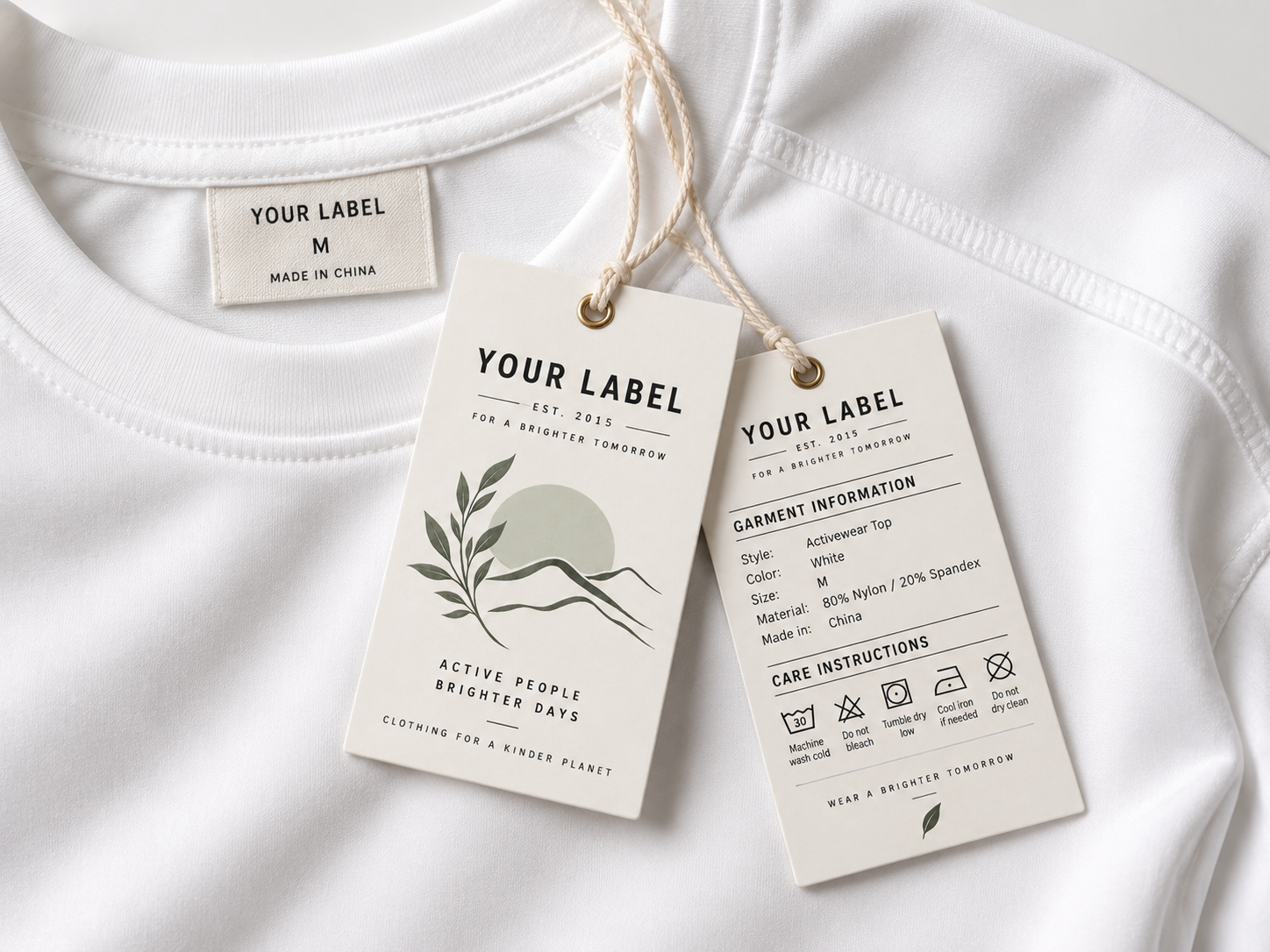
Garment Labels
Main, size and care labels establish the brand and product identity on the garment. Artwork, content, dimensions and placement should match the approved garment specification. Market-specific care versions need clear file control so the correct information reaches the correct style and SKU. Label planning can also distinguish shared brand identity from product-specific information, helping a collection keep a consistent look without forcing every style into one identical construction.
- Main brand, size and care labels.
- Woven labels by arrangement; heat transfer where suitable.
- Approved content and placement linked to garment files.
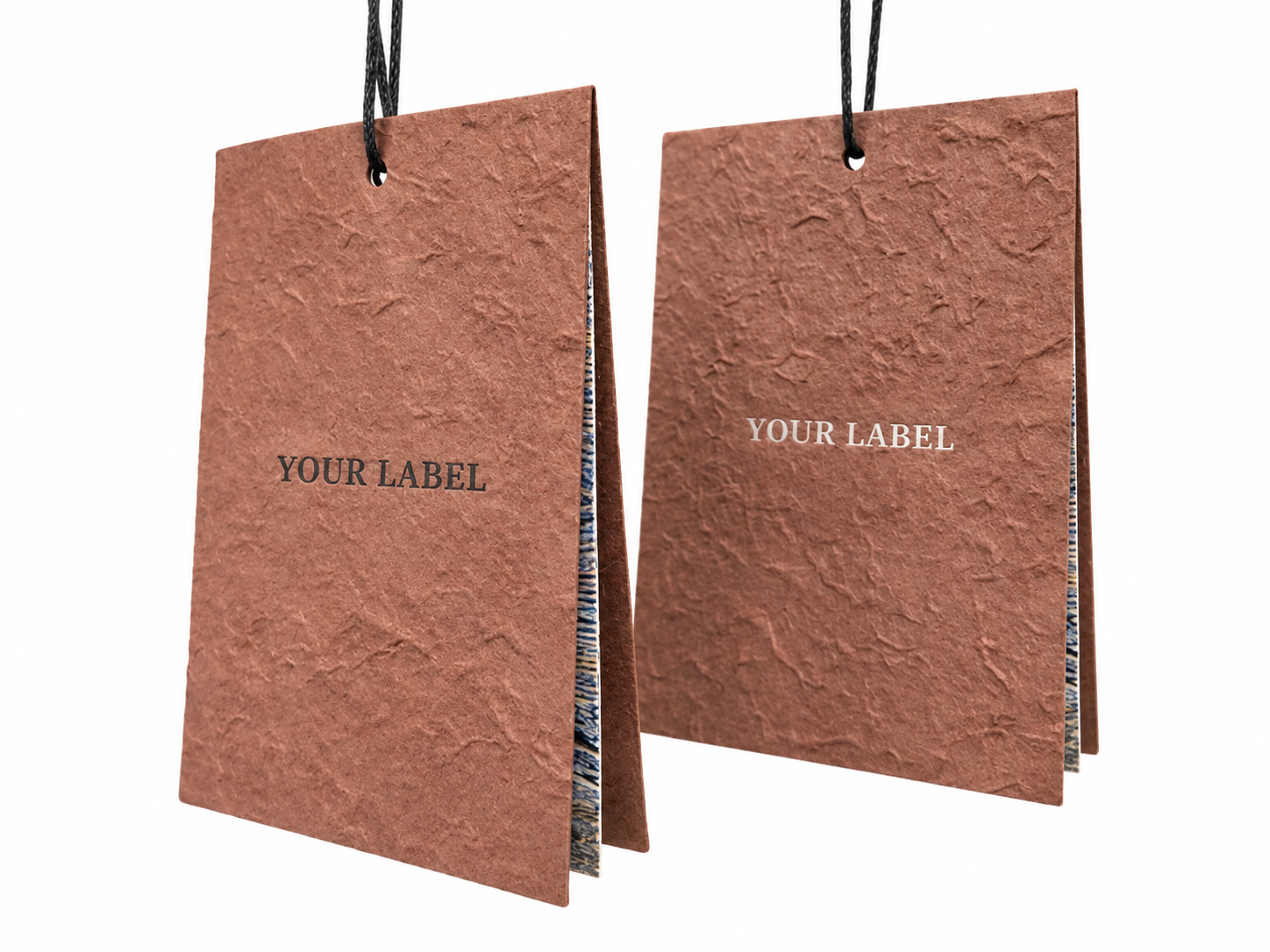
Hangtags and Cards
Hangtags and paper cards add brand or retail communication outside the garment. Their artwork, dimensions, hole or attachment location, barcode content and market version should be planned alongside the garment rather than after production is complete. Market-specific price or language versions should be mapped clearly so the correct card follows the correct SKU during final packing and shipment preparation. The attachment method and final placement should also be checked on the real garment so the hangtag does not distort delicate fabrics or obscure important product details during presentation.
- Brand or product cards.
- Customer-provided barcode data where applicable.
- Physical sample approval by project.

Individual Packaging
Polybags, paper cards, retail boxes and other approved individual packaging can be reviewed according to the product and sales channel. Fold method, bag or box dimensions, warning text, stickers and SKU labels need to match the packed garment. Approved folding and pack-out instructions should be tested with the real garment because product thickness, structure and size can affect the required packaging dimensions. Where different markets use different inserts, warnings or stickers, each package version should be linked to the SKU matrix before material is ordered.
- Standard or custom packaging options by project.
- Packaging MOQ confirmed after artwork and material review.
- Retail or e-commerce requirements reviewed according to the program.
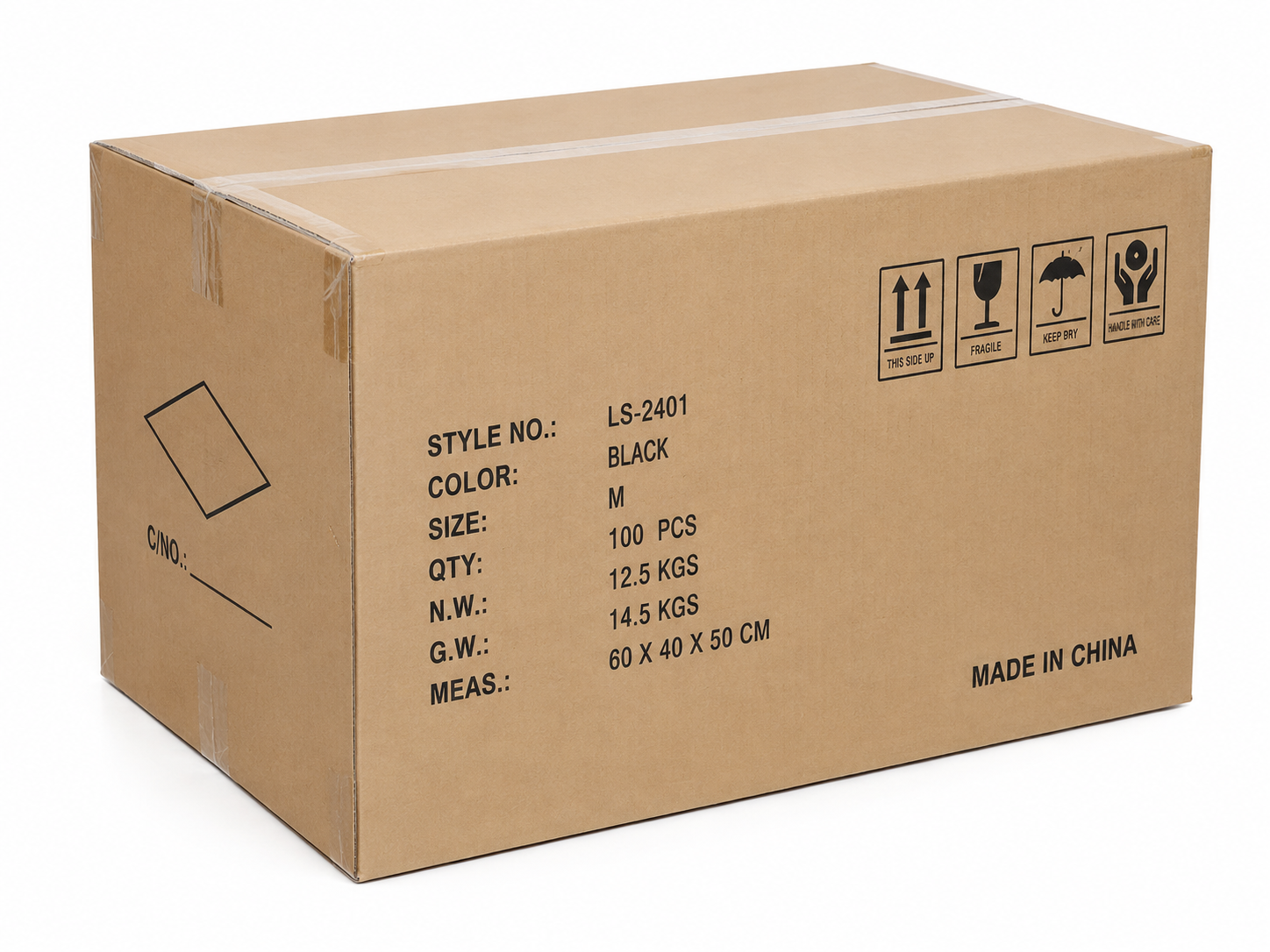
Carton Identification
Outer cartons carry order-level identification such as carton marks, SKU information or packing instructions. The content should match the approved packing plan and shipment documents. Mixed-SKU or multi-warehouse arrangements require especially clear carton-level files. Carton files should be checked against the latest SKU allocation and packing list so outer identification supports receiving and distribution instead of creating a second source of truth. For split deliveries, warehouse or destination codes should be approved before carton printing so final identification follows the actual distribution plan.
- Custom carton markings.
- Mixed-SKU packing by arrangement.
- Market and warehouse instructions should be version-controlled.
Bulk Label and Packaging Quality Checks
Leadshow has an approximately 45-person quality team supporting material, in-process, finished-garment and packaging checks according to project requirements. Label inspection follows approved specifications rather than a universal zero-defect or 100% inspection promise.
Content Accuracy
Label text should match the latest approved files. Care information, size, style code, country-of-origin wording and market language versions need a clear source. Wrong content can make an otherwise acceptable garment unusable for the intended program. If a care label is revised after garment production begins, the affected styles, quantities and markets should be identified before the new version is released so mixed content is not introduced unintentionally. Production records should make it clear which version was released and when.
- Check against approved artwork and content.
- Confirm market and language version.
- Separate obsolete files from released production files.
Position and Size
Main labels, size labels, care labels and heat-transfer marks should appear at the approved location and orientation. Dimensions can also affect how a label sits in the garment. Inspection criteria should define what is important for the approved design. Where a brand uses the same label on several styles, the approved placement reference may still vary by product construction, so each style should retain its own position instruction. Approved tolerance or reference points can be added when visual placement is critical.
- Position and orientation.
- Width × height where specified.
- Relationship to seam, neck, waist or other reference point.
Workmanship
Sewn labels should be secure and visually aligned according to the garment standard. Heat-transfer labels should follow the approved appearance and application result. Loose stitching, distortion, damaged label edges or visibly poor application can be identified during relevant inspections. Inspection can also compare the applied label with the approved sample for orientation, smoothness and overall presentation, while any durability claim remains subject to the agreed material and test requirement. Any recurring issue should be traced back to the relevant application method or production instruction.
- Attachment and visual condition.
- Heat-transfer appearance where used.
- Garment interaction and visible defects.
SKU Matching
Size, style, color and market-specific labels need to match the correct garment. Multi-SKU programs require extra care because visually similar products can use different labels or care versions. The SKU matrix should remain available to production and packing teams. Packing teams benefit from a visible matrix or released work instruction showing the correct label and packaging combination for each active SKU, especially when several market versions share similar garments. Random spot checks can be arranged according to the agreed inspection scope and order risk.
- Style × color × size match.
- Market-version match.
- Label version linked to SKU record.
Barcode and Packing
Customer-provided barcodes, SKU stickers, bag labels and carton marks should correspond to the packed product and approved files. Where scanning is required, the exact method and scope should be agreed rather than assumed as a universal 100% barcode scanning service. Sensitive commercial data should be handled as project information and should not be displayed publicly. The brand remains the source of truth for barcode ownership and approved data. Printed readability should be protected from smudging, folding or label placement that obscures the code.
- Barcode file and printed data match.
- Bag label matches garment SKU.
- Carton marks align with packing instructions.
Final Review
A final review may combine garment appearance, labels, hangtags, packaging and shipment-preparation records according to the order requirements. Sampling level, defect classification and acceptance criteria are agreed by project. Approved inspection does not mean every unit is guaranteed defect-free. A clear disposition record for any rejected, reworked or held quantity helps separate open issues from accepted goods and prevents the same problem from carrying into packing or reorder preparation. Final status should be recorded before goods are released for shipment preparation.
- Review against approved project criteria.
- Document any identified issue and disposition.
- Release only according to the agreed inspection arrangement.
Manufacturing Foundation Behind Your Apparel Program
Labels sit inside a broader garment supply program. Leadshow’s confirmed manufacturing scale supports apparel development, sampling, multi-SKU production, quality review and packing while label-specific supplier conditions remain separately evaluated.
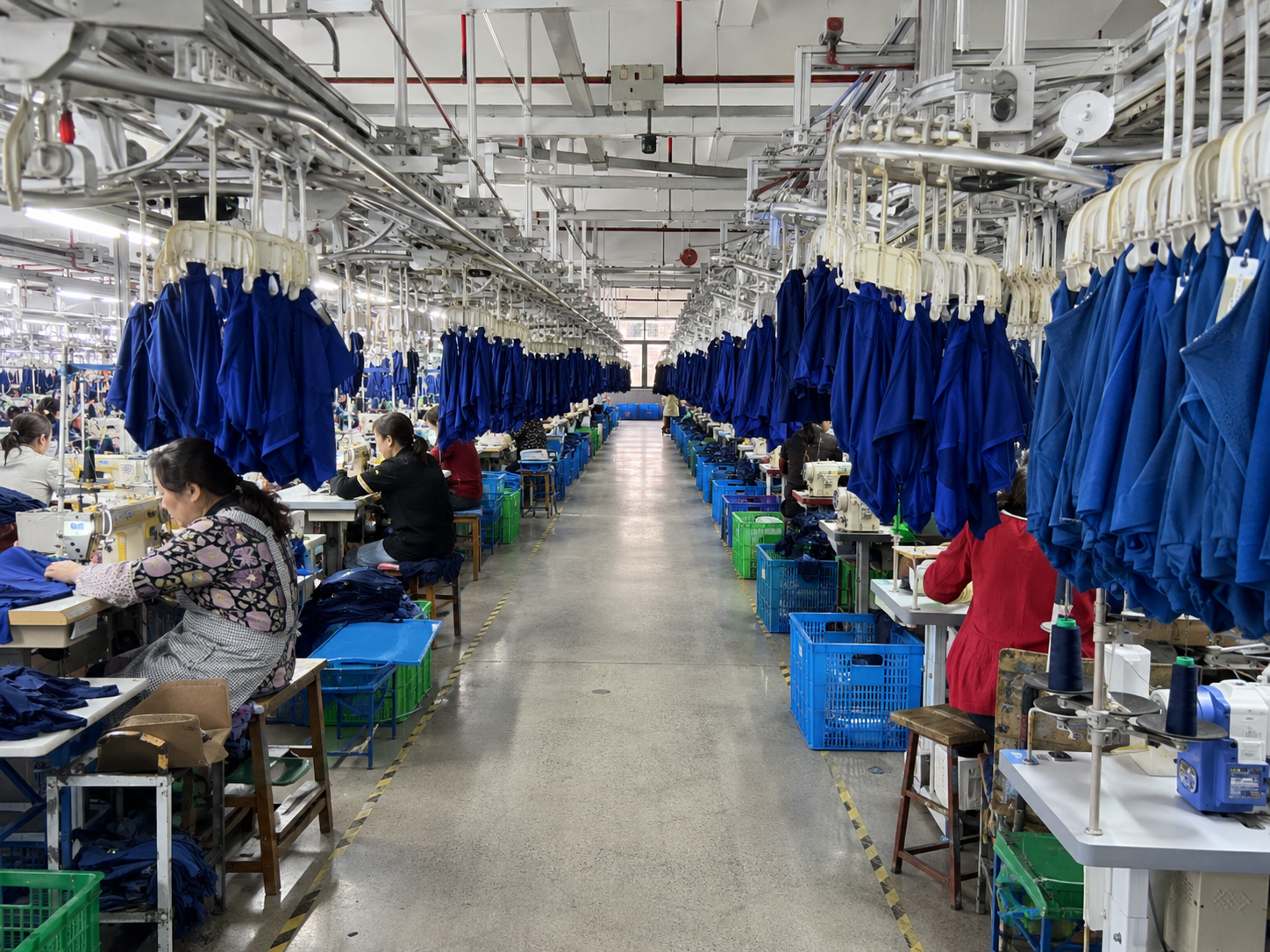
15 Years Experience
Leadshow has 15 years of apparel industry experience. The figure should be understood as industry and product-development experience, not a claim about a specific founding year. Experience supports communication around garment construction, sampling and bulk execution, including the label and packaging details that connect approved brand files to finished products. The value lies in using that experience to interpret apparel details and production risks rather than turning the number into an unsupported claim of market leadership.
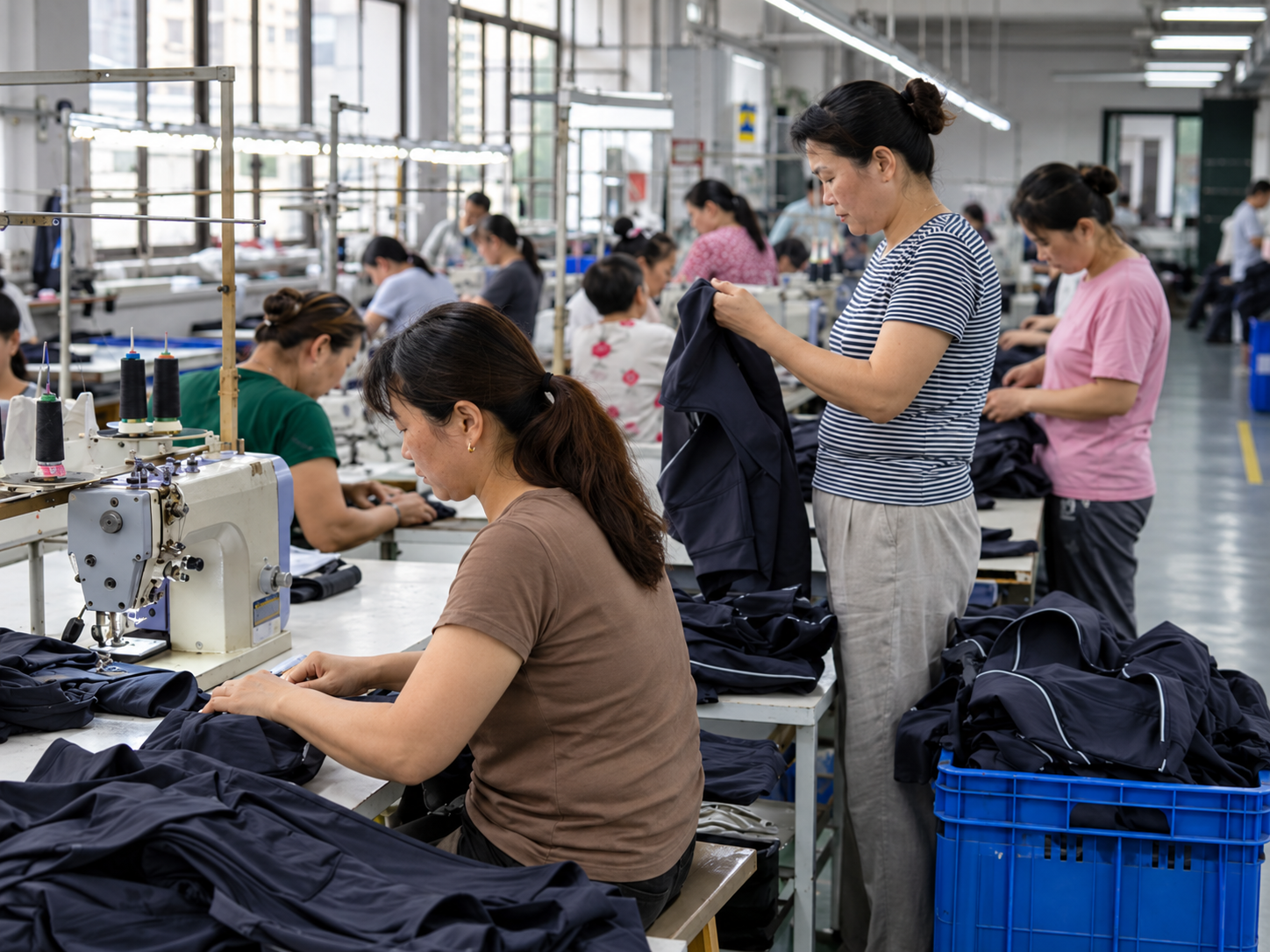
3 Manufacturing Bases
Leadshow operates three manufacturing bases as part of its overall apparel manufacturing system. The three-base figure is a combined company fact and does not mean every base contains the same equipment or label processes. Project allocation and available capacity are reviewed according to the product, order and current production plan. The figure supports scale and scheduling flexibility while remaining subject to the actual project mix and the confirmed capabilities of the assigned production resources.
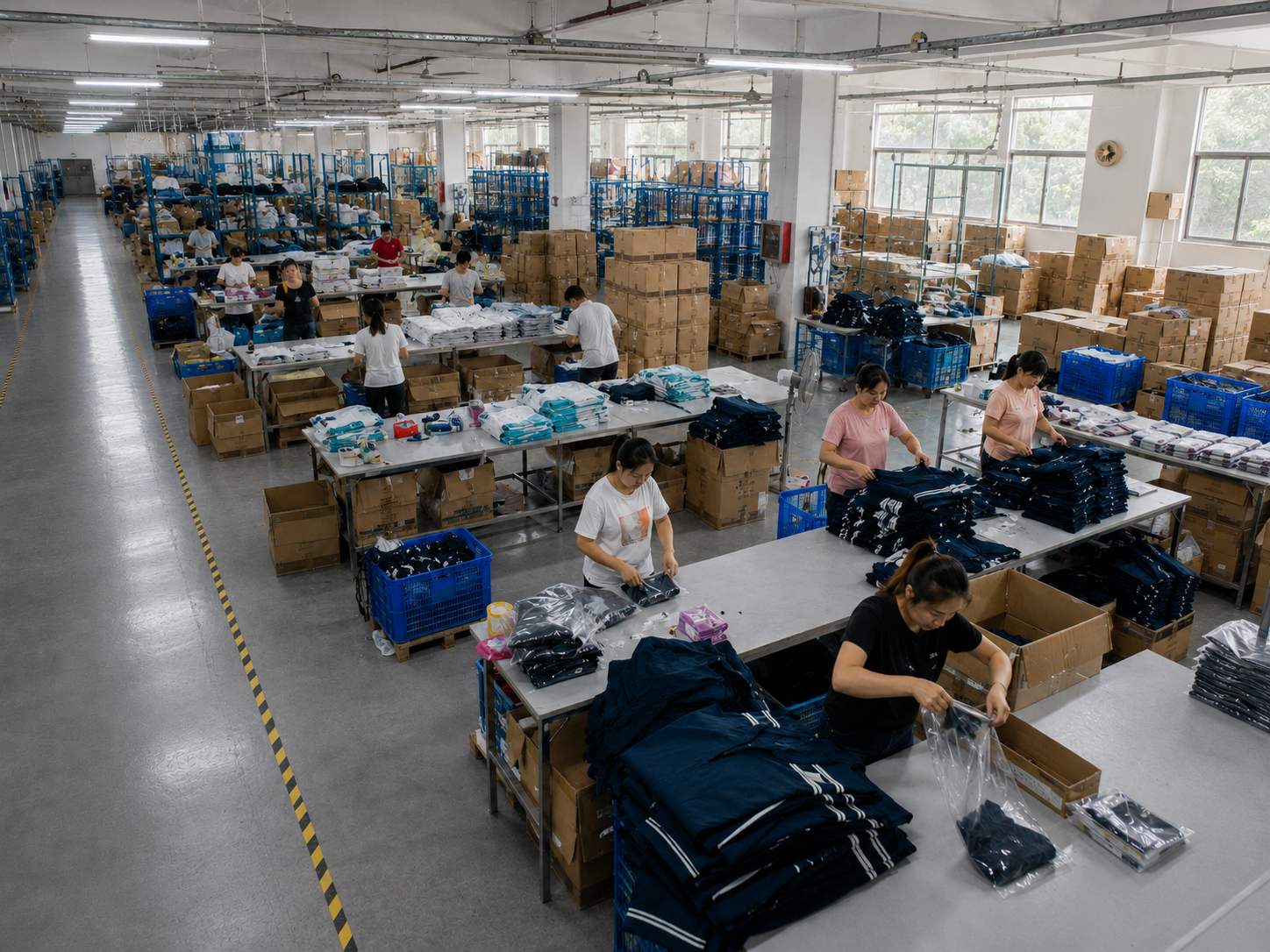
20,000+ Square Meters
The combined factory area across Leadshow’s manufacturing system exceeds 20,000 square meters. The figure supports an integrated manufacturing base covering sampling, production, finishing, warehousing and related functions. It should not be interpreted as the area of one factory, one workshop or a dedicated label facility. It supports the broader apparel operation and should be presented as combined facilities rather than as a dedicated label-production footprint.
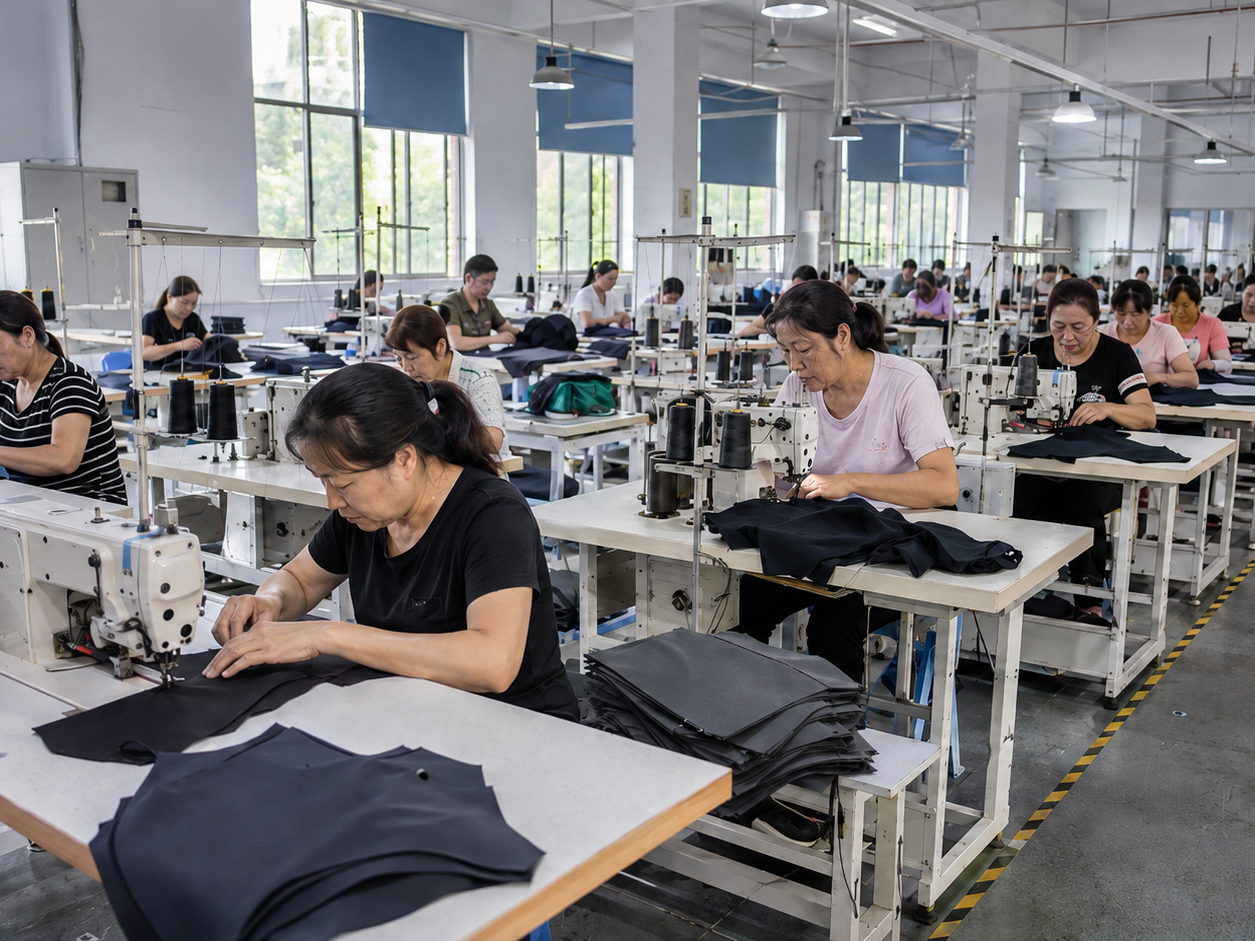
1,500+ Team Members
Leadshow has a team of more than 1,500 employees across business communication, product development, manufacturing, quality, warehousing, logistics and support functions. Team scale helps coordinate complex apparel programs, but it does not mean every order receives a dedicated project team or that all employees perform the same role. The figure is a company-wide team scale and should not be converted into a claim about 1,500 label specialists or a fixed workforce for one order.
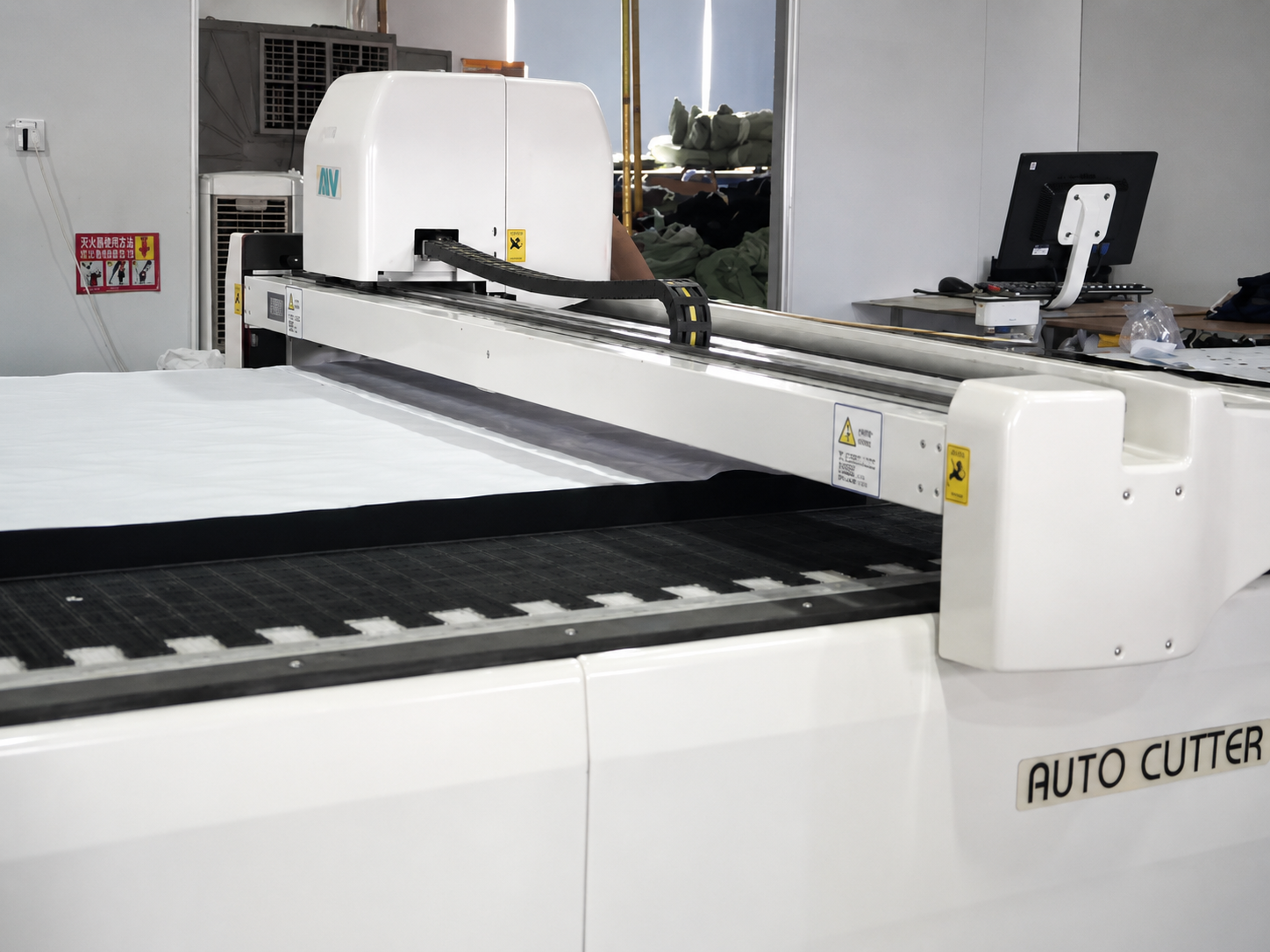
304 Confirmed Machines
Leadshow has 304 confirmed production and finishing machines in the current equipment record, with additional equipment items whose quantities remain unconfirmed. The mix includes cutting, sewing, flatlock, bonding, heat-transfer, finishing and packing equipment. Equipment supports apparel execution but should not be used to claim every process is completed in-house. Label-related work should reference only the equipment actually confirmed for the relevant process, such as heat-transfer equipment, rather than the total machine count alone.
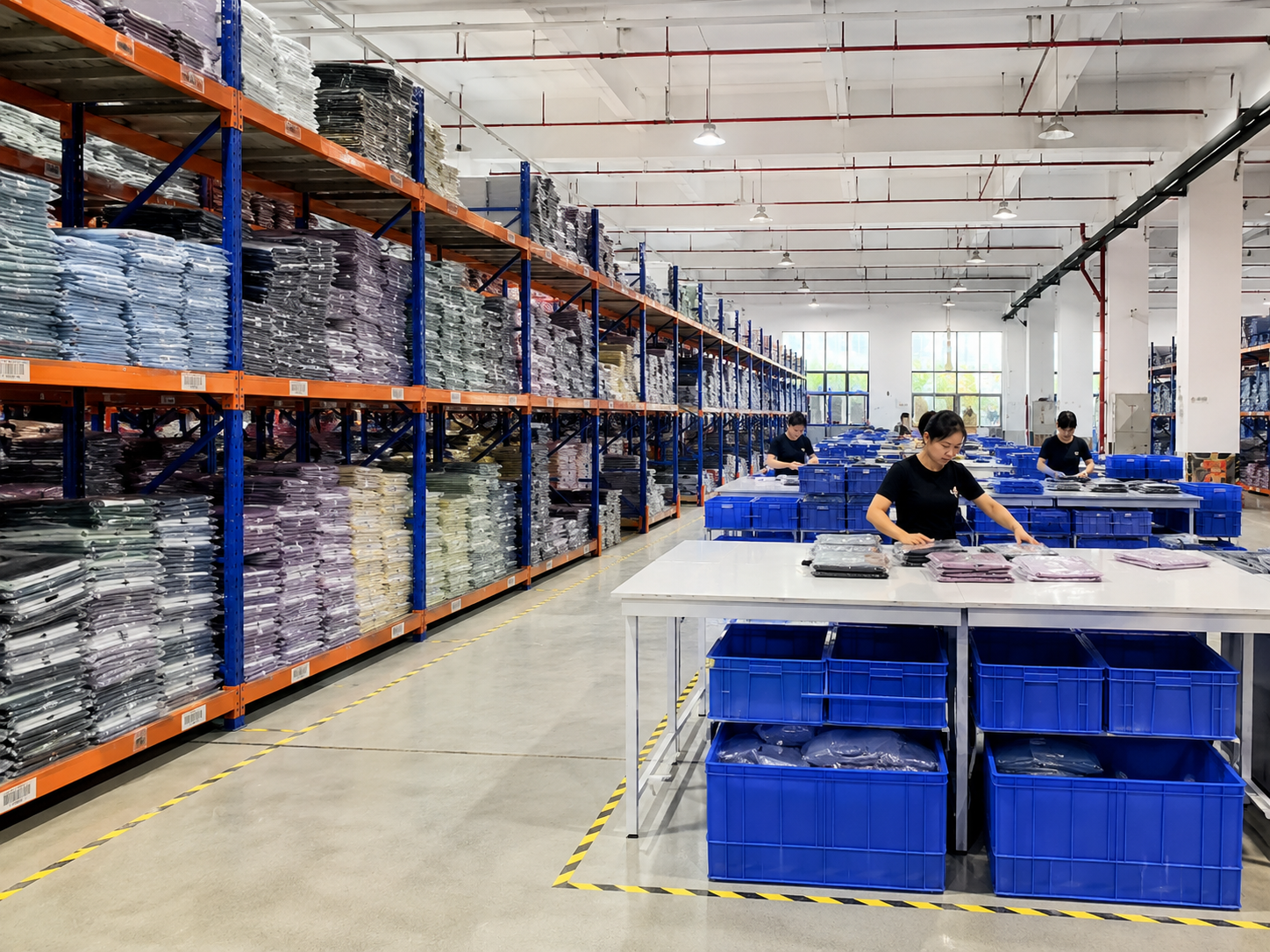
Up to Approx. 120,000
The three manufacturing bases provide a combined monthly capacity of up to approximately 120,000 finished garments, subject to product construction, materials, workmanship, order mix, quality requirements and current scheduling. The figure describes finished-garment capacity and must not be presented as label output or guaranteed capacity reserved for one project. Available capacity for a specific order is confirmed only after product complexity, materials, quantities, SKU mix and the current production schedule are reviewed.
MOQ and Cost Factors for Labelled Apparel
Garment MOQ, label MOQ, packaging MOQ and project timing are related but not identical. Accurate commercial terms depend on the apparel construction, label format, artwork versions, quantity, materials, supplier conditions and current production schedule.
Item
Confirmed Baseline / Input
What Can Change It
When Confirmed
Garment MOQ
Starts from 100 pieces per color per design
Fabric, trims, construction, customization, colorways and supplier requirements
After product and material review
Label size
Width × height in mm supplied or approved per design
Artwork detail, content volume, fold/finish, placement and application method
Before label sample
Woven / sourced label MOQ
Separate supplier MOQ may apply
Material, label type, size, colors, finish and supplier policy
After supplier review
Custom packaging MOQ
Separate supplier MOQ may apply
Artwork, packaging material, structure, print and supplier conditions
After artwork and material review
Label sample timing
Project-specific; no fixed universal period
Artwork readiness, supplier process, material and approval steps
After specification review
Garment sample timing
Project-specific
Product complexity, materials, workmanship, testing and revision requirements
After garment development review
Bulk production timing
Project-specific
Material readiness, label/packaging approval, order mix and current scheduling
After pre-production conditions are confirmed
Delivery timing
Project-specific after cargo readiness
Shipment method, destination and forwarder arrangement
After shipping plan is agreed
Keeping Label Standards Stable Across Repeat Orders
Repeat orders work best when approved artwork, dimensions, care content, SKU logic and packaging versions remain documented. Historical files help continuity, while materials, supplier conditions and current market requirements still need reconfirmation.
Store Approved Artwork, Dimensions and Placement as Versioned Files
A repeat order should start from the latest approved project record rather than memory. The record can include main-label artwork, woven or printed label specification, heat-transfer file, label dimensions, placement, size matrix, care content, hangtag artwork, packaging version and carton marking. Version control matters because small changes accumulate over time: a logo may be resized, a care instruction updated, a regional language added or a packaging layout revised. If old and new files remain mixed together, a reorder can easily reproduce an obsolete detail. Leadshow can coordinate approved brand labels and packaging while managing artwork, versions, SKUs and market-specific requirements as part of an apparel project. The safest workflow gives every released file a clear status and removes superseded files from the active production set. Repeat-order continuity means building from approved records; it does not mean materials, supplier prices or market rules remain permanently unchanged.
A simple naming rule can also prevent confusion, for example separating development, approved and obsolete files instead of relying on dates alone. The approved record should identify the garment style and any market scope so teams can tell whether a file is universal or limited to one region. When a physical label sample is approved, its reference can be connected to the digital file, giving repeat orders both a visual standard and an editable source. If the artwork later changes, the new version should not silently overwrite the historical record; keeping the prior approval visible makes it easier to understand what changed and why.
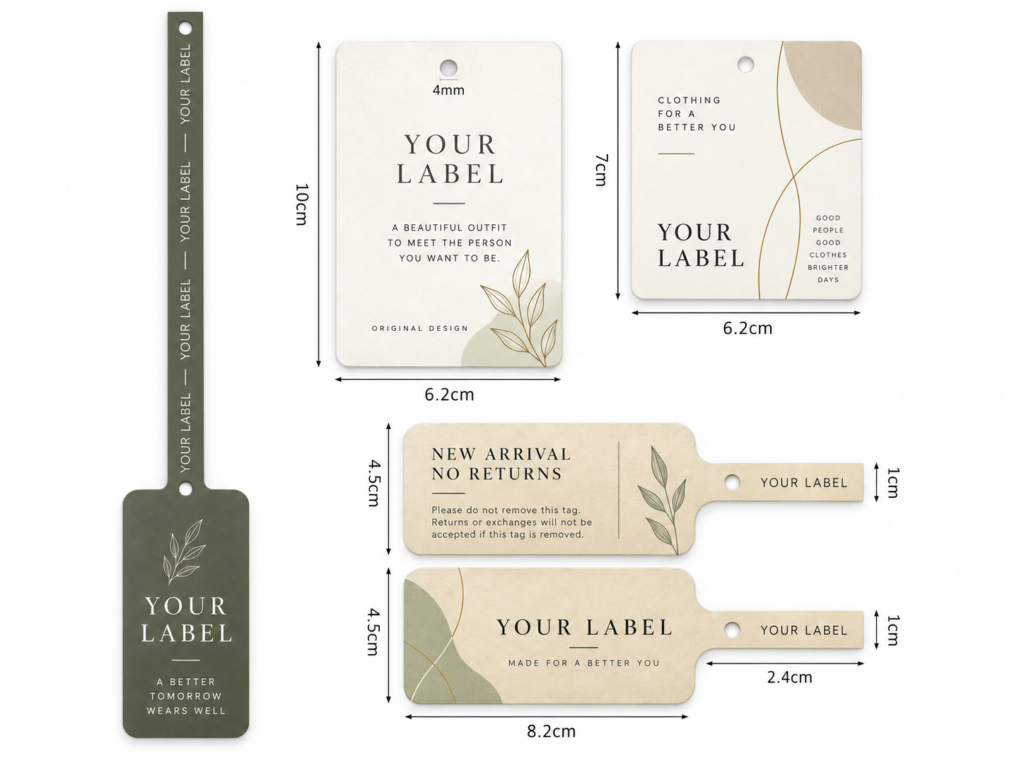
Reconnect Label Versions to SKU and Market Requirements
A brand may keep the same garment style while changing color, size range, market or packaging. Each change can affect labels. A new size adds size-label variants. A new market may require a different care-language file. A new retail channel may require different barcode or packaging information. For that reason, the reorder review should reconnect the style, color and size matrix to the current label and packaging versions before production files are released. Where several market versions share one garment, the correct SKU-to-label mapping becomes essential. Barcode data should come from approved brand or retailer files, and any country-of-origin or regulatory information should be reconfirmed for the intended destination.
A controlled matrix makes differences visible before production rather than after packing. Multi-SKU support is valuable only when the program can distinguish what is shared and what must remain market- or SKU-specific. A current quantity allocation should be reviewed at the same time because one care-label version may serve only part of the total order. If a SKU is discontinued, added or moved to a different market, the active label matrix should be updated before any reprint. The same rule applies to hangtags and packaging. Keeping all linked elements under one matrix prevents a common reorder mistake in which the garment specification is current but the accompanying brand or retail files belong to an earlier sales program.
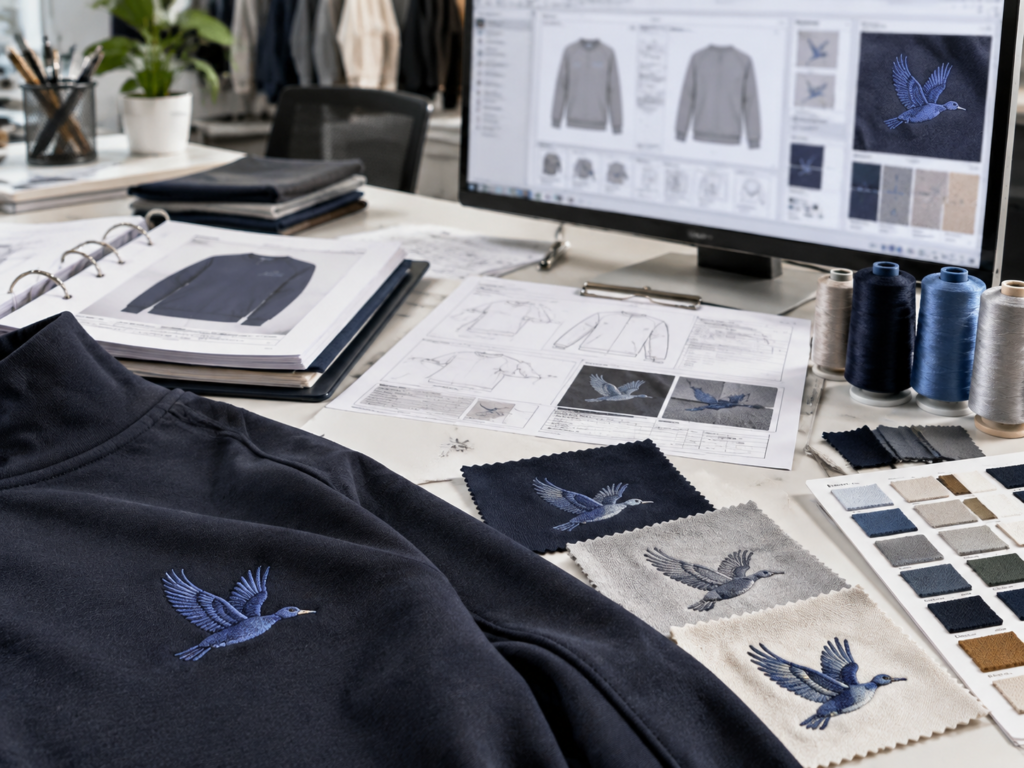
Reconfirm Materials, Supplier Conditions and Care Information Before Reorder
Repeat orders often look simple because the design already exists, yet external conditions can change. A woven label supplier may update minimums or material availability. Packaging stock may change. A garment material substitution can affect a heat-transfer application. Care information may need revision if the fiber composition changes. For those reasons, the previous approved sample is a reference, not a promise that every input will remain identical forever. Leadshow’s confirmed long-term reorder support is most reliable when key inputs are checked again: garment fabric, label material, supplier availability, packaging, care content, market and production schedule. Where the same specification is still available, the archived record can speed review.
Where something has changed, the impact should be assessed before new labels or packaging are produced. Such reconfirmation protects brand continuity more effectively than assuming a past order can be copied without review. Commercial teams should also review whether the previous supplier MOQ and timing still fit the new quantity. A small reorder can create different label economics from the original bulk run, while a large expansion can justify a different production arrangement. Any claimed environmental, recycled or certified material attribute should be reconfirmed from current evidence rather than carried forward from an old assumption. Such checks protect both brand accuracy and quotation quality before the reorder is formally accepted.
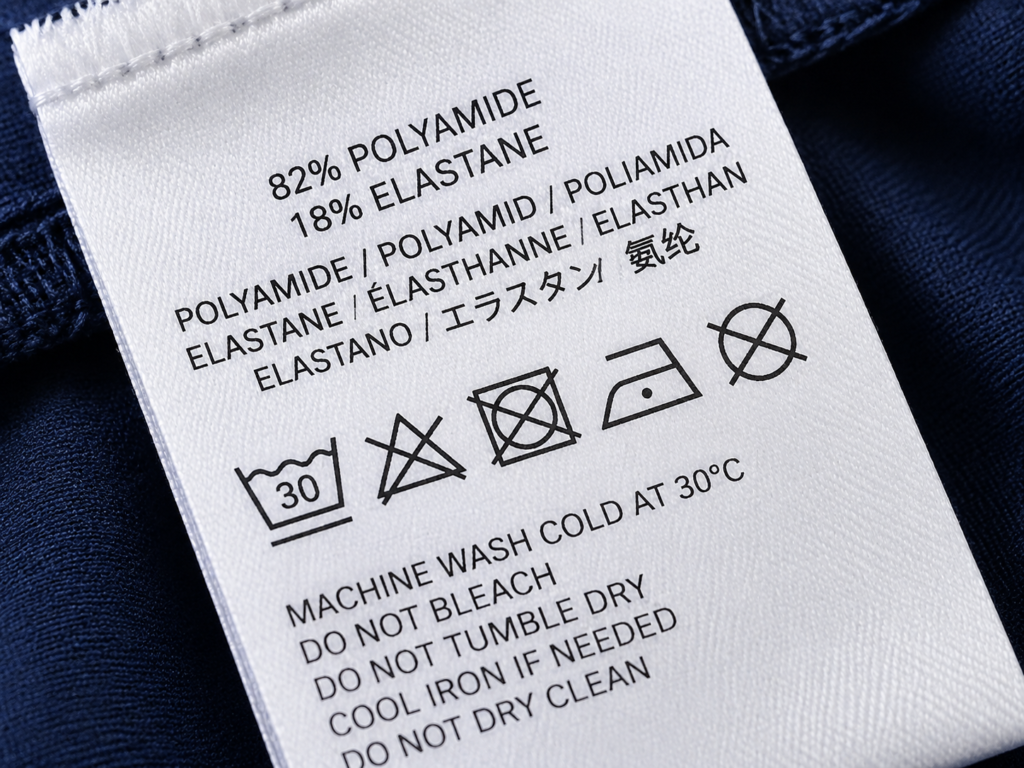
Use Approved Samples and Project Records During Bulk Execution
Once a repeat order is released, bulk production should reference the approved garment, latest project files and confirmed label and packaging versions. Production and quality teams can then compare current execution with the agreed references. Checks may include label content, position, size, attachment, SKU relationship, hangtags and packaging, according to the project inspection plan. The goal is repeatable execution within reasonable manufacturing tolerances, not a claim that every physical item will be absolutely identical. If a discrepancy is found, the affected quantity, file version and production stage need to be identified so the appropriate corrective action can be evaluated.
Strong reorder support depends on records, approvals and coordinated execution, allowing brands to preserve product identity while still responding to current materials, regulations and commercial conditions. Production teams can keep the approved sample accessible at the relevant stage and use the released matrix to check which label and packaging version applies. Quality teams can record any deviation against the same reference, giving later investigation a clear starting point. When a correction is approved, the change should flow back to the project file so the final released record reflects what was actually produced. That discipline makes the next reorder easier to evaluate and reduces the risk of repeating a resolved issue simply because the archive was never updated.
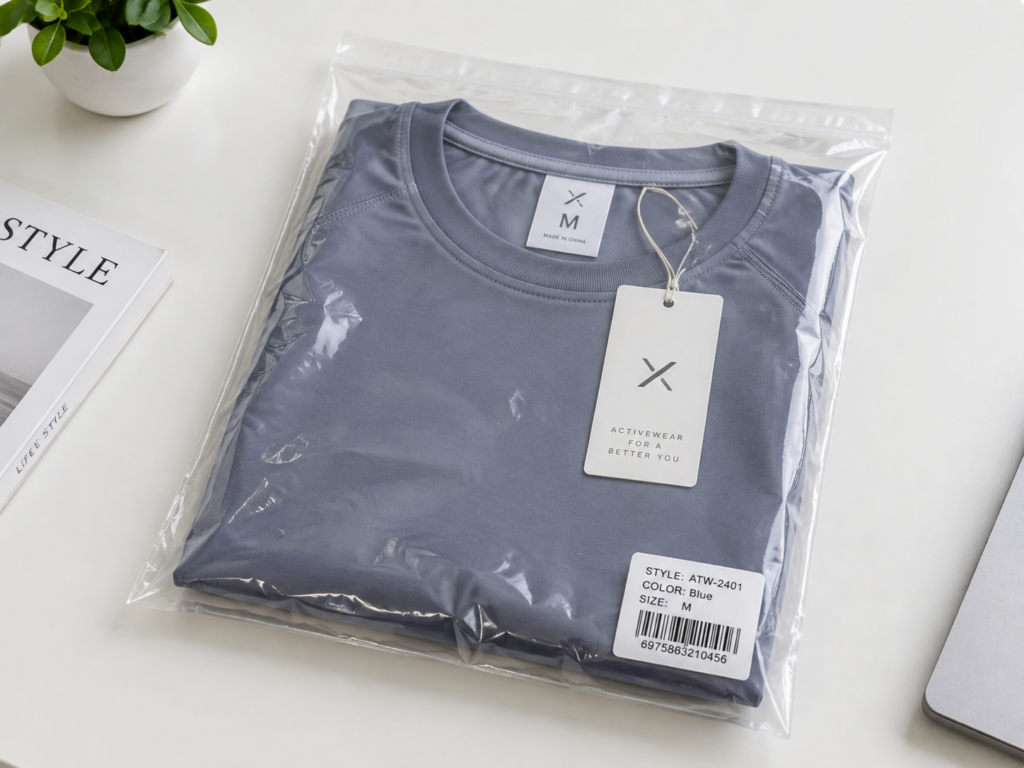
Custom Clothing Labels RFQ Checklist
A complete RFQ shortens clarification and helps separate garment, label, packaging and market requirements. Files do not need to be perfect, but the following inputs allow a more meaningful review than a request containing only a logo.
RFQ Information
Preferred Format
Priority
Notes
Garment type and style
Tech pack, sketch, photo or reference sample
Required
Identify the apparel product using the label
Logo / brand artwork
AI, EPS, PDF, SVG or other production-ready vector; high-resolution image if vector is unavailable
Required
Authorization must be clear for protected artwork
Label type
Main, woven, printed care, heat transfer, size, hangtag or other requested format
Helpful
Can be reviewed if not yet finalized
Label dimensions
Width × height in mm
Helpful
Confirm physical size before sample approval
Placement
Annotated garment drawing or written position
Required
Include attachment or heat-application direction where applicable
Care content
Approved composition, care instructions, origin and other text
Required where applicable
Brand/importer confirms legal content
Size range
Approved size matrix
Required
Links size labels to garment sizes
Colorways
Color list and approved references
Required
Helps map label and packaging variants
SKU / barcode files
Spreadsheet, PDF or approved data file
For multi-SKU / retail programs
Barcode data should be supplied and approved by the brand
Destination market
Country/region or market program
Required
Determines market-specific review needs
Garment quantity
Pieces per design, color and size
Required
Needed for MOQ and commercial review
Packaging requirements
Artwork, reference images or packing manual
If applicable
Separate supplier MOQ may apply
Target schedule
Requested sample and bulk milestones
Helpful
Final timing confirmed after project review
Custom Clothing Labels Frequently Asked Questions
Answers below cover the label questions most often raised during private-label apparel development, sampling, SKU planning and bulk production.
What custom clothing labels can Leadshow support?
Leadshow can review main labels, printed care labels, custom size labels, woven labels by arrangement, heat-transfer labels where suitable, and hangtags as part of apparel manufacturing projects. Final materials, supplier conditions, MOQ, timing and application method are confirmed by project.
Can Leadshow make woven clothing labels?
Woven labels can be arranged within apparel projects. Leadshow does not claim all woven labels are produced in-house. Artwork, dimensions, finish, attachment method, supplier MOQ and timing are reviewed before a commercial commitment is made.
Can you produce heat-transfer labels?
Yes, selected heat-transfer main, size and care labels can be evaluated. Leadshow has confirmed heat-transfer label equipment. Fabric compatibility, label size, placement, application conditions and any durability requirement need review before bulk use.
What information should appear on a care label?
Care-label content may include approved fiber composition, care instructions, size, country of origin, style information, languages and other required product details. The brand or importer should confirm the legal content for the destination market.
Who confirms legal label content for each market?
The brand, importer or responsible party should provide and approve the applicable content. Leadshow can coordinate production and application according to approved files and destination-market requirements, but does not independently guarantee legal labeling for every market.
What artwork files should I provide?
Production-ready vector artwork is preferred. Provide label dimensions, brand colors, placement, size information, care content, market, quantities and any SKU or barcode files. High-resolution artwork can be reviewed when vector files are unavailable.
Can labels be reviewed before bulk production?
Yes. Depending on the project, review may include a label sample, heat-transfer application sample, hangtag or packaging sample, and the label as applied to a garment. Timing is confirmed after specifications, materials and supplier conditions are understood.
Do custom labels have separate MOQs?
They can. Leadshow’s standard garment MOQ starts from 100 pieces per color per design, subject to project conditions. Woven labels, printed items and custom packaging may have separate supplier MOQs and lead times.
Can labels be controlled across multiple SKUs?
Yes. Style, color, size, label version, care version, barcode and packaging can be mapped in a SKU matrix. Approved data should remain version-controlled before production and packing so the correct labels follow the correct garments.
Can labels and packaging be coordinated together?
Yes. Main labels, size labels, care labels, hangtags, barcodes, individual packaging, paper cards, retail boxes and carton markings can be reviewed together as part of a private-label apparel program, subject to project and supplier conditions.
Submit Your Apparel Label Requirements
Start with the files already available. A useful project review can begin from a tech pack, garment drawing, reference sample, logo artwork or a current product that needs to be transferred to a new manufacturing program. Include the garment type, requested label formats, width × height where known, placement, brand colors, care content, size range, SKU or barcode files, quantity per style and color, destination market, packaging requirements and target schedule. Leadshow will review label requirements as part of the apparel project and identify which items can be handled internally, which require supplier coordination, and which specifications still need approval. Garment MOQ starts from 100 pieces per color per design under applicable project conditions; custom labels and packaging may carry separate supplier MOQs and lead times. Sample and bulk timing are confirmed after materials, artwork, construction, production scheduling and revision requirements are understood. Files containing protected brands or artwork should be submitted only when appropriate use rights are available.